Monthly Archives: August 2026

KAOS at the Pit Tips

Somewhere underneath the landscaping, redevelopment and general passage of more than thirty years, I like to imagine there is still a faint chalk mark on a forgotten piece of concrete at the former Gedling Colliery.

KAOS.

There almost certainly isn’t. The surface I wrote it on has probably long since disappeared, and chalk was never built for posterity.

But for a brief period in the early 1990s, KAOS was my tag. When I say a brief period, it was likely just one afternoon.

I should probably explain.

When I was in my mid-teens, a friend and I spent quite a lot of time exploring the bits of Nottingham that were not really intended to be explored. This was the early 1990s, when teenagers seemed to enjoy considerably more freedom to disappear for hours at a time without anybody being entirely sure where they were.

Or perhaps our parents just made a serious error of judgement regarding just how sensible we’d be on our very loose leashes!

One of our favourite destinations was Pit Tips—our name for the sprawling remains of the recently closed Gedling Colliery.

Our timing, although we did not appreciate it then, was rather extraordinary.

Gedling Colliery had closed in November 1991 after nearly ninety years of mining. If my memory is right, our expeditions were around 1992 or 1993. We were not exploring some ancient industrial ruin that had been abandoned for decades. The place had barely stopped being a working coal mine.

Today, when something survives from our industrial past, there tends to be a nice path, an interpretation board and perhaps a QR code.

This was not like that.

There were still buildings. There was still machinery. Conveyor belts and great pieces of industrial equipment whose purpose I could not have explained then and certainly cannot now. Astonishingly in retrospect, two teenage boys could apparently just wander into some of it.

I have very clear memories of being inside those buildings.

I do not remember encountering security. I do not remember particularly substantial fences. I do not even remember having the sense that getting inside was especially difficult.

Fortunately, I also do not remember finding anything that offered access underground. Gedling’s mine shafts descended hundreds of metres beneath the surface, so I am extremely grateful that our particular brand of teenage curiosity remained resolutely above ground.

At the colliery, at least.

Because we had another underground playground nearby.

But before we get to that, there is the small matter of the vandalism.

Teenage delinquents. Sort of.

On at least one expedition to Pit Tips, we had gone prepared.

We took chalk.

Because while we clearly considered ourselves pretty badass, we apparently were not badass enough for spray paint.

Armed with our terrifying arsenal of coloured calcium carbonate, we liberally decorated bits of the abandoned colliery with our chosen tags.

Those tags provide an almost perfect way of dating the experience.

My friend chose Warchild.

Warchild was one of the surfers in Point Break, released in 1991 and therefore still relatively new. We were both into skateboarding at the time—although neither of us was especially good at it—so a Point Break-inspired alter ego probably made perfect sense to us. It was a respectable choice for a teenage boy attempting to establish an edgy identity.

I chose KAOS.

Not after a film. Not after a gang member. Not after anything anybody without an Amiga was particularly likely to recognise.

KAOS was a section from the first Megademo by a Danish Amiga demo group called Budbrain.

Even my teenage rebellion was nerdy.

Amiga demos were awesome

For anyone who missed that particular corner of home-computer culture, demos were programmers, musicians and graphic artists showing off. Groups produced increasingly elaborate demonstrations of what they could persuade computers like the Amiga to do, often seemingly exceeding what the hardware ought to have been capable of.

They spread on floppy disks, copied from friend to friend, and the best became minor legends among Amiga owners.

Budbrain’s first Megademo appeared in 1990 and included a section called KAOS. It clearly made enough of an impression on teenage me that I adopted it as my nom de vandalism.

So naturally I wrote it all over a recently abandoned coal mine.

In chalk.

Move over, Banksy.

Beneath the Pepper Pots

Pit Tips was not the only enticingly inadvisable place nearby.

Hidden in the trees was the eastern portal of Mapperley Railway Tunnel.

The tunnel had once carried the Great Northern Railway beneath the ridge between Gedling and Woodthorpe. Opened in 1875, it ran for 1,132 yards—just over a kilometre—before emerging on the other side of the hill near what is now Weaverthorpe Road.

By the time we found it, trains had not run through it for more than thirty years.

Getting there meant following the old railway cutting through the trees. One landmark I remember particularly clearly was an old burned-out Ford Fiesta sitting not far from the tunnel portal.

Because of course there was.

It was an abandoned railway cutting in Nottingham in the early 1990s. It would almost have been suspicious if there had not been a burned-out car in it.

The tunnel portal itself was simply open.

There may have been signs telling us not to enter. There may even have been some token attempt to discourage access that I have forgotten.

But whatever was there clearly was not sufficient to defeat two teenagers.

So in we went.

The tunnel had two ventilation shafts along its length, topped at ground level by structures locally known as the Pepper Pots, for the fairly obvious reason that that is what they looked like.

We knew them from above as well as below. At least one formed part of the site used by a local Scout group, and we had been to bonfire parties there.

Underneath, one of the shafts demonstrated another long-established local tradition: chucking rubbish into any sufficiently large hole.

People had apparently been using it as a convenient vertical dumping ground for years, resulting in an enormous cone of detritus piled on the tunnel floor beneath it.

We carried on past it.

Mapperley Tunnel had suffered badly from mining subsidence during its operational life, including a major collapse in the 1920s. After the railway closed, part of the tunnel was eventually filled.

But not quite all the way to the roof.

This was important.

Because if you are a teenage boy and somebody has gone to the trouble of filling an unsafe railway tunnel with tonnes of material but has accidentally left a narrowing gap above it, you do not interpret this as “clearly we should turn around.”

You interpret it as a challenge.

At first we could walk normally. Then we had to duck. Then duck a little further.

The ground kept rising towards the roof.

Somewhere beyond the earth ahead of us was the western portal near Weaverthorpe Road. Another Scout group had premises nearby, and friends who went there brought back tantalising reports that somebody had once dug around the buried portal and reckoned there was open tunnel behind it.

That was all the evidence we required.

We did not make it through.

Eventually the gap became sufficiently small that even our teenage brains began to register that crawling further into a partially filled railway tunnel with a long history of subsidence might not be entirely sensible.

I think we got to somewhere around where Plains Road runs overhead before finally admitting defeat.

Looking back, I find it reassuring that we apparently possessed some instinct for self-preservation.

It just kicked in considerably later than would generally be recommended.

There was also something beautifully circular about the whole expedition. One of the Pepper Pots above us was associated with one Scout group. Our mythical destination was beside another.

We were, quite literally, passing underneath one Scout group in a vain attempt to reach another.

Going back

Years later, I went back. I wrote about it on here, in fact.

By then the entrance was fenced off, which was probably a sensible development.

There was still a way in.

Which was probably less sensible.

In 2012, I returned with friends, better torches and the vastly improved judgement and maturity that comes with adulthood.

We went into the tunnel again.

We passed beneath the Pepper Pots again.

We reached the backfill again.

And we carried on until the steadily diminishing headroom persuaded us to turn around.

Again.

So apparently the principal difference between teenage me and adult me was better illumination.

What had changed much more dramatically was the world outside the tunnel.

The Gedling Colliery I remembered was gone.

The buildings we had wandered through disappeared as the site was cleared. The machinery and conveyors vanished. Nature gradually reclaimed areas that had once been dominated by heavy industry.

Even the waste recycling centre that had arrived on the site in the 1990s had gone, another brief role for the landscape blinked in and out of existence between my forays.

Eventually, much of the former colliery became Gedling Country Park.

It is, objectively, a much nicer place.

But it is almost impossible for me to walk around there without mentally superimposing another landscape on top of it.

I remember Pit Tips.

And I think that is what fascinates me most about these memories.

We happened to catch Gedling Colliery between identities.

For nearly ninety years, it had been a workplace. Thousands of people had passed through its gates. Generations had earned their living there. Coal had been hauled from hundreds of metres beneath the ground.

Then, in 1991, it stopped.

For a relatively brief period afterwards, the infrastructure remained but its purpose had gone.

And into that gap wandered two teenage boys with some chalk.

Today, I suppose what we were doing would be called urban exploration. There would be photographs, YouTube videos and online communities devoted to it.

We did not know we were urban explorers, we were making memories, not content.

We were just going to Pit Tips.

There is always a danger when remembering childhood of concluding that everything was better then.

It was not.

And I am not convinced that teenagers being able to wander unchallenged through recently abandoned coal-mining infrastructure and then disappear into a condemned railway tunnel represents an unambiguous triumph of early-1990s childhood.

In hindsight, some of it was bloody stupid.

But I am still glad we did it.

Because places in transition have always fascinated me. There is something exciting about somewhere whose original purpose has ended but whose next purpose has not yet arrived. The people have gone, but the physical evidence of what they did there remains.

Eventually somebody decides what happens next.

The buildings come down. The machinery is removed. The fences go up. The landscaping begins. Trees grow. Paths appear. Houses arrive.

And gradually the place you knew survives only in photographs and memories.

I suspect the days when people can wander into Mapperley Tunnel are numbered too. Development is pushing ever closer and, entirely reasonably, an open entrance into an unstable Victorian railway tunnel is not the sort of neighbourhood feature developers generally advertise in the brochure.

Perhaps one day it really will become inaccessible.

Perhaps that is no bad thing.

But whenever I pass that part of Nottingham, there is still another version of the landscape tucked away in my head.

A burned-out Fiesta in the cutting.

A black tunnel mouth in the trees.

Pepper Pots overhead.

The remains of a coal mine that had only just stopped being a coal mine.

And somewhere amongst it all, two teenage idiots wandering around with a box of chalk.

One of them was Warchild.

And the other—because apparently I was incapable of being cool even while trespassing—was KAOS.
Categories: Blog | Tags: , , , , , , , , , , , , , , | Leave a comment

The Lost Blackbird Song: The Blackbird Sings Again!

Back in 2011, I wrote about a song I remembered from primary school. It came from some sort of musical about a songwriting competition, in which one character wrote a beautiful song about a blackbird and another, less scrupulous character tried to steal it. To counter this, the protagonist wrote a decoy dirge-like song with the aim of that being stolen by the villain. I could remember the tune clearly (not hard, it was one note!) and, more remarkably, four lines of the lyric:

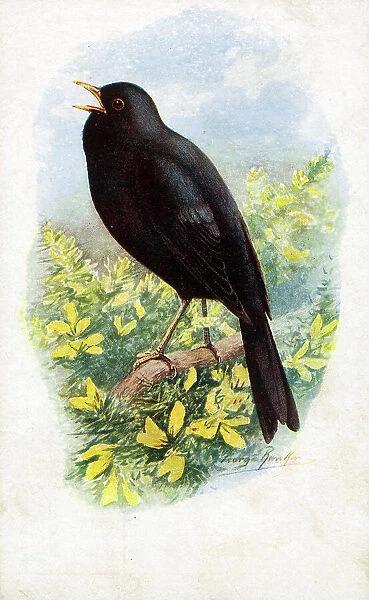
The blackbird sings a tuneful song,
With turns and trills so fine;
Such skill has he, such majesty,
But it’s not as good as mine.

What I could not remember was what the musical was called, who had written it, or where our school had obtained it. Nobody else I spoke to seemed to recognise it. Internet searches produced nothing, and so the song remained one of those odd fragments of childhood that somehow survive after almost everything surrounding them has disappeared.

Fourteen years later, in December 2025, I returned to the mystery. The internet had grown considerably since 2011, but the blackbird song remained stubbornly absent from it. I wrote a follow-up post, partly to gather together what little I knew and partly in the hope that someone else might eventually type one of those remembered lines into a search engine and find me.

That is exactly what happened.

In January, Paul left a comment saying that he remembered the song too. He believed it had been performed by Lucie Skeaping in a BBC schools programme called The Music Arcade, sometime around 1983 or 1984. He also remembered a character called Harlequin.

That last detail helped to unlock some more fragments from my memory. Once Paul had supplied the name, more of the story began to fall into place: Harlequin was trying to trick Pantaloon in a song competition.

There was a slight complication, though. Harlequin and Pantaloon aren’t exactly obscure characters. They go back to the Italian commedia dell’arte tradition and became familiar figures in British harlequinades and pantomime. So adding Harlequin and Pantaloon to my searches wasn’t quite the breakthrough it might have seemed.

Still, Paul independently remembering the same song, the same characters and The Music Arcade was far more than I’d had before.

Paul and I exchanged a few emails at the time, comparing memories and trying to pin down the programme. It was already enormously satisfying simply to discover that somebody else remembered the same thing. This was no longer an obscure childhood memory that apparently belonged only to me. Paul remembered it too.

At that point, though, we still didn’t have a recording, or anything else that definitively proved we’d landed on the right thing.

Then, completely out of the blue, another email from Paul arrived today.

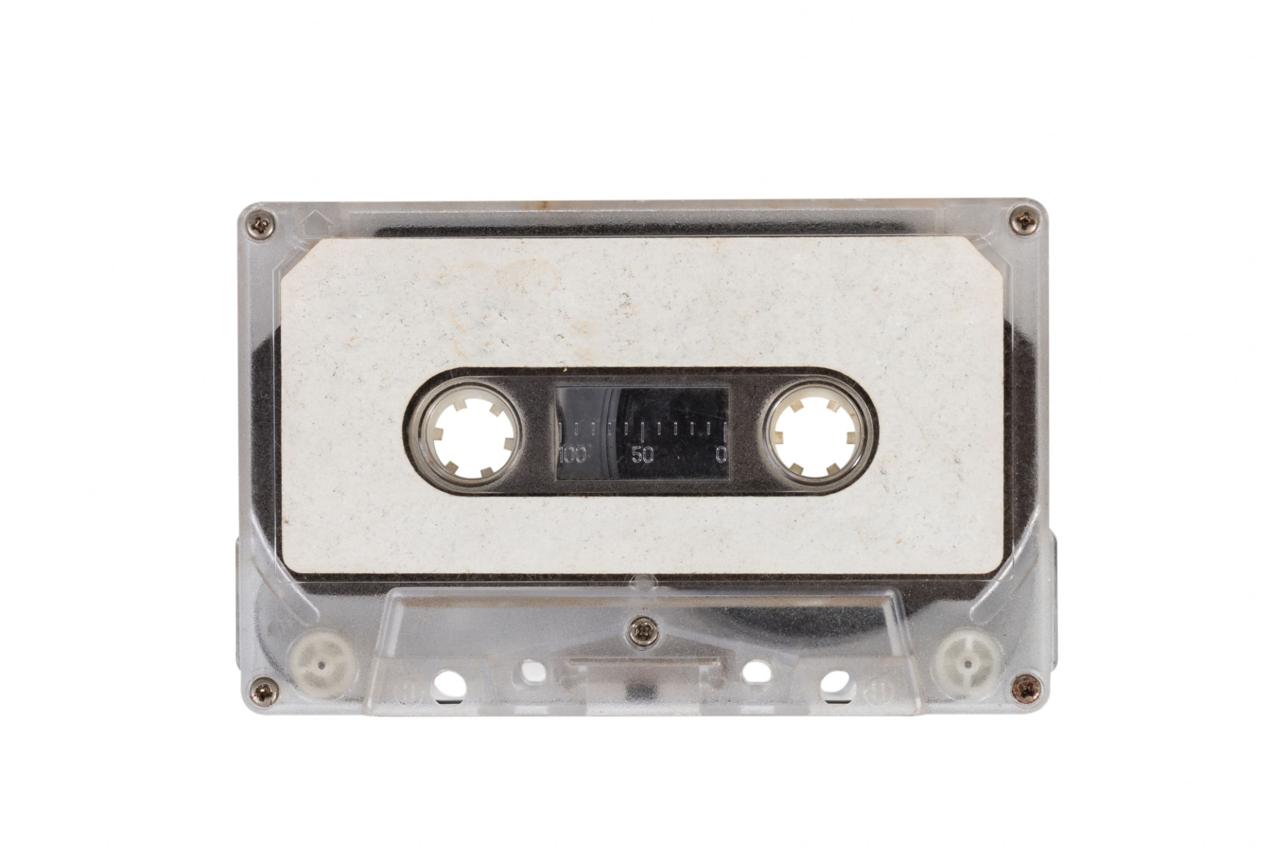
He had been looking through some old cassette tapes for something entirely unrelated when he came across an unmarked tape. On it were recordings from The Music Arcade — including the blackbird song!

Even more wonderfully, he remembered our exchange from seven months earlier and took the trouble to convert the recordings to MP3 and send them to me.

Bless him for that.

The first recording even comes complete with an unmistakable bit of BBC continuity:

“This is Daytime on Two. Time now to visit The Music Arcade, to listen to some vocal sounds.”

Hearing that alone is oddly transporting. There is something about the sound of old BBC schools television — the continuity voice, the slightly formal presentation, the piano and orchestral arrangement — that instantly evokes classrooms, television trolleys and programmes watched in the middle of an ordinary school day.

And then there’s the song itself.

It is exactly the song I remembered, albeit with a female vocalist, while the version in my head has always featured a male voice — presumably one of our teachers.

There are a few more orchestral flourishes than our primary-school production managed, unsurprisingly, but the tune (or lack thereof) is unmistakable. More gratifyingly still, the lyrics I had been carrying around in my head for all those years weren’t merely close. They were spot on:

The blackbird sings a tuneful song,
With turns and trills so fine;
Such skill has he, such majesty,
But it’s not as good as mine!

When Paul first commented, he wondered whether the third line might have been “such talent has he, such artistry”. It turns out that, on this occasion at least, my memory had preserved the original wording with remarkable accuracy.

The recordings also confirm the wider story. Harlequin is trying to trick Pantaloon in a song competition, and the rival composition really is the deliberately dreadful one-note song I remembered. After decades of wondering whether I had merged several childhood memories together, there it all is: Harlequin, Pantaloon, the blackbird, the stolen song, the competition and the gloriously terrible alternative.

There is something rather strange about hearing a piece of music that has existed for so long only as an internal recording. Usually, rediscovering something from childhood reveals how much memory has altered it. The voice is different, the tempo is wrong, or the remembered fragment turns out to bear only a passing resemblance to the real thing.

In this case, pressing play didn’t replace my memory with the original. It confirmed that the original had been there all along.

The ending is also almost comically appropriate. In my previous post, while describing how easily school music vanished in the years before digital archives, I wrote:

Fold up the lyric sheets.
Box up the cassette.
Move on to the next term’s topic.

And that, apparently, is more or less what happened.

The recording survived not in an online archive or a carefully labelled collection, but on an unmarked cassette Paul happened to find while searching for something else.

The cassette had been boxed up. It was simply waiting for the right person to open the box again.

My original 2011 post was effectively a message in a bottle. Fourteen years later, I sent out another one. This time Paul found it. His own memory led him to the blog, and months afterwards a chance encounter with an anonymous cassette completed the story.

So the lost blackbird song is lost no longer.

And after all these years, the blackbird still sings a tuneful song — with turns and trills so fine.

Huge thanks to Paul for reaching out and sharing these recordings. Maybe we aren’t the only two people out there with this song living rent-free in our heads, and this will prove some kind of therapy for others!

Categories: Blog | Tags: , , , , , | Leave a comment

Wherever I lay my map..

There is a Gabrielle Aplin song called Home that I’ve always loved, although when I hear it in my head it isn’t necessarily Gabrielle singing it. My friend Paige used to perform a genuinely spellbinding cover of it, back before she decided to hang up her guitar — a decision I continue to regard as a minor cultural tragedy. I haven’t heard her sing it for years, but her version is still the one that tends to live in my head.

The song has always resonated with me because of the distinction it makes between a house and a home. They’re words we use almost interchangeably, but they’re really not the same thing. A house is bricks and mortar, an address, somewhere that can be pinpointed precisely on a map. Home is considerably harder to locate.

Which got me thinking about the places I’ve called home.

There are seven of them. Or possibly eight, if we’re being pedantic, because my first ever accommodation was Highbury Hospital in Nottingham, where I was born. It was a maternity hospital then. It’s a mental health hospital now. There is almost certainly a joke available there at my expense, but in an unusual display of restraint I’m going to leave it for somebody else to make.

What struck me when I plotted the seven actual homes on a map was how remarkably unadventurous my geographical life has been. Five of them are in or immediately around Nottingham. Even when I eventually summoned the courage to extricate myself from its orbit, I didn’t exactly trouble the passport office. Ella’s migration from Stevenage to eventually arrive at the same final dot on my map is considerably more impressive than anything I’ve managed.

But while the distances between some of those dots are tiny, the lives lived at them feel enormous.

Mapperley (pt 1)

Kent Road was home before I had any concept that there was an alternative. I came back there from Highbury Hospital as a baby and lived there until I was around nine or ten. It was simply home, in that absolute childhood sense of the word. I hadn’t chosen it, paid for it, worried about its value or wondered whether the commute was sensible. It was where Mum and Dad lived and therefore where I lived.

It’s strange looking at a childhood home as an adult because the building remains resolutely physical while so much of what made it important doesn’t. Somebody else can occupy the rooms, decorate them differently, change the garden, replace the windows. The house carries on perfectly happily without you. Meanwhile, somewhere in your head, an entirely different version remains preserved.

Perhaps that’s the first lesson in the difference between houses and homes: you can leave one while somehow retaining the other.

Mapperley (pt 2)

Our family moved to Fernleigh Avenue when I was around nine or ten, which means this was the house that saw considerably more versions of me.

Childhood became adolescence there, adolescence became early adulthood, and at some difficult-to-identify point I went from being a child who lived with his parents to an adult who… still lived with his parents.

It was the base for school, teenage years, university and eventually the beginning of working life. And although Kent Road was my first home, Fernleigh probably did more of the heavy lifting in turning me into whatever it is I eventually became.

The first two dots on my map are actually comically close together. Geographically, I had barely moved. Personally, almost everything had.

Then, at around 21 or 22, having graduated from university and acquired my first “proper job”, it was finally time to leave.

Wollaton

Woodhall Road was different from everything that came before it because this one was my decision.

I rented it with a work colleague. It was the first time I’d had the freedom — and responsibility — of living somewhere that wasn’t ultimately Mum and Dad’s problem. It was also, it would be fair to say, a bit of a party house.

Freedom and responsibility don’t necessarily arrive in equal proportions when you’re in your early twenties.

There were bills to pay, food to buy, rooms to clean and all the other tedious infrastructure of adult existence that had previously happened suspiciously automatically. There were also friends, parties and the novelty of having a front door that belonged to us.

It didn’t go amazingly well.

Perhaps that’s part of leaving home too. The first attempt doesn’t have to become somewhere you stay forever. Sometimes the significance of a place is simply that you went there and discovered you could survive outside the family home — albeit with varying degrees of competence.

Woodhall Road was home as an experiment.

Netherfield

Godfrey Street was different again.

This was the first house I bought.

There’s something psychologically significant about that first mortgage payment. Renting somewhere means it’s your home, certainly, but buying somewhere introduces a rather more alarming sense of permanence. Nobody else is ultimately responsible for the building anymore. If something breaks, there isn’t a landlord to ring. The frighteningly large number on the mortgage statement belongs entirely to you.

For the first time I could point at a building and say, in the most literal possible sense, that’s mine.

It turns out, though, that ownership isn’t the same thing as permanence either.

Godfrey Street was an important stage rather than the destination. Another dot appeared on the map.

Gedling

Ullswater Close was the first house I bought with somebody else — and that gave the word home another meaning again.

This wasn’t simply somewhere I’d chosen to live. It was somewhere built around an idea of a shared future.

Of course, not every imagined future happens.

We split up and the house was sold, and suddenly my neat progression through adulthood — parents’ house, rented house, first house, shared house — stopped looking quite so neat.

There’s something peculiar about leaving a home because a relationship has ended. The bricks haven’t failed. The roof hasn’t fallen in. The postcode remains exactly where it always was. But the thing that made that particular building your home has disappeared.

And so, for the first time since my early twenties, I went back to my parents.

Except I didn’t actually go back home.

Hathern

By this point Mum and Dad lived in Hathern, near Loughborough. So although I was retreating to parentville for a while, I wasn’t returning to either of my childhood homes. I was moving into a house that was home to my parents but had never previously been home to me.

It was a temporary landing place while I worked out what came next.

At roughly the same time another significant change happened. I’d moved jobs from Boots in Nottingham to a new role in Solihull, which created a practical geographical problem. Nottingham still exerted a fairly substantial gravitational pull on my life, but travelling from there to Solihull every day wasn’t especially attractive either.

So my next home began not with a grand emotional attachment to a particular town, but with something considerably more romantic:

I drew a triangle on a map.

I wanted somewhere that worked for commuting towards Solihull while still keeping me within sensible reach of Nottingham. Somewhere inside that rough area was where the next stage of life would happen.

And eventually that exercise led me to a place called Woodville.

Woodville

There was no childhood connection to Woodville. No lifelong ambition to live here. No moment when I stood on a hill, gazed across South Derbyshire and thought, one day, all this will be mine.

It was, initially, a practical answer to a geographical problem.

And yet this is the dot that stuck.

Somewhere along the way, the house selected partly because it was in approximately the right place became home in a way that none of those practical calculations could have predicted.

Life accumulated around it.

Then Ella arrived, having undertaken a considerably more ambitious migration from Stevenage than my decades of increasingly elaborate manoeuvres around the East Midlands. Two completely different lines on the map eventually converged on the same little dot in Woodville.

And that changes a house too.

Looking at the map now, perhaps that’s the thing I find most interesting. Seven completely ordinary buildings have acquired enormous significance simply because, for a while, my life happened inside them. Other people lived in most of them before me. Other people live in most of them now. Remove the memories and they’re just addresses.

But I can’t remove the memories.

Kent Road remains childhood. Fernleigh Avenue contains school, teenage years and the long runway into adulthood. Woodhall Road is freedom, parties and the slightly chaotic first attempt at independence. Godfrey Street is the terrifying excitement of owning something. Ullswater is a shared future that didn’t happen. Hathern is retreat, regrouping and deciding what came next.

And Woodville is home.

Perhaps that’s why Home still gets to me — particularly when the version playing in my head is Paige’s.

A song is another thing that can become detached from where it originally came from. Gabrielle Aplin recorded it, but somewhere along the way Paige’s version became my version. She doesn’t perform it anymore, much to my perpetual sadness, but I can still hear it.

Places seem to work like that too.

I could drive back to Mapperley tomorrow and stand outside Kent Road or Fernleigh Avenue. The buildings would still be there. But I couldn’t really go back home to either of them, because the homes I remember don’t physically exist anymore. They’re populated by different versions of my family, my friends and myself. They’re places I’ve carried away with me.

And perhaps that’s ultimately what a home is.

Not a dot on a map, or a name on a mortgage statement, or even somewhere you necessarily stay.

It’s what happens there, who you share it with, and what remains with you after you’ve left.

Seven addresses. One fairly small corner of England. And, somehow, an entire life between them.

There’s only one way to sign this off, Paige playing Home.

Categories: Blog | Tags: , , , | 1 Comment

The brown belt that never was

Somewhere in my teenage years there was a version of me who was going to be a brown belt at judo.

I know this because I’d already bought the belt.

I was a blue belt by then and brown was next. I hadn’t actually earned it, obviously, but apparently I was sufficiently confident in the inevitable march of progress that buying one in advance seemed perfectly reasonable.

I never wore it.

There wasn’t a dramatic ending to my judo career. I didn’t get injured, fall out with anybody or decide that judo and I were finished. I just became a teenager. Other things gradually became more interesting and, at some point I can’t even remember, I stopped going.

I’ve occasionally wondered what happened to that brown belt. More recently I’ve started wondering what might have happened if I’d actually worn it.

How I ended up doing judo in the first place is another slightly hazy childhood memory. My brother Rich had started going to karate lessons and I dimly remember going along and watching. In my memory at least, it bore a slightly alarming resemblance to Cobra Kai from the original Karate Kid film: lots of shouting, discipline and an instructor who seemed considerably more frightening than anybody involved in a children’s hobby had any obvious need to be.

Whether it was actually like that or whether forty years of memory and repeated exposure to The Karate Kid have gradually merged the two together, I couldn’t possibly say.

Either way, we didn’t become karate kids.

Somehow judo entered the picture instead, and Rich and I ended up at Nottingham Olympic Judo Club on St Stephen’s Road in Sneinton.

It was walking past there recently that started me thinking about all this again. The old club is flats now, because apparently nearly forty years is sufficient time for the world to rearrange itself without asking permission. Seeing the building again dislodged a collection of names I hadn’t properly thought about in decades.

Our instructors were John Mewett and Dave Lawrence. I could probably make this sound rather more martial-arts-like by referring to them as Sensei Mewett and Sensei Lawrence, but that isn’t how I remember them. They were John and Dave. That’s what we called them then and that’s still how they exist in my head.

I had no real idea who Dave and John were outside that room. Why would I? Adults don’t really have biographies when you’re a child. They’re just the adults who happen to occupy a particular part of your world.

There was Bruce too, older than us, dark-haired and exceptionally good. I remember him as something of John’s protégé. John’s son Dan trained there as well, although I’m not sure I ever thought of him as Dan. He was Diggy.

Then there was Rolly and his sister, whose name frustratingly refuses to come back to me. I remember her, though, not least because she managed to break her collarbone during one of our club trips, which is an unfortunate way to ensure you remain part of somebody else’s childhood memories even after they’ve forgotten your name.

There was Siân, on whom I had a bit of a crush, and her sister Karen. I’m sure there were others. Perhaps their names will come back tomorrow while I’m making a cup of tea or doing something else entirely unrelated.

It’s peculiar which names survive.

One of the strangest additions to that list came more recently. A friend called Mark, whom I met many years later through an entirely different part of my life, happened to mention that he’d trained at Nottingham Olympic too, at around the same time. Neither of us remembers the other being there. Perhaps our periods at the club didn’t quite overlap. Or perhaps we stood ten feet apart every week for years without ever really noticing one another.

I rather like the possibility that we did.

At the time, of course, none of us were nostalgic characters in somebody’s future story. We were just kids doing judo.

Nearly forty years later, naturally, I disappeared down a rabbit hole.

It turns out John and Dave weren’t simply two blokes who happened to be good at judo. John had been a British lightweight champion and competed at high level himself before becoming heavily involved in coaching, apparently spreading himself across something of a Venn diagram of clubs and schools around the East Midlands.

Dave had considerable pedigree of his own. He’d been a three-time British Open champion and represented Great Britain internationally. Between them, Rich and I had somehow wandered into a little judo club in Sneinton and ended up being taught by two men who’d operated at the top end of British judo.

We had absolutely no appreciation of this at the time.

John was John. Dave was Dave. They were the blokes who taught us judo.

Bruce really was as good as I remembered too. He went on to become a British junior champion, joined the national squad and competed internationally. Better still, in a contemporary newspaper interview he specifically credited John with giving him his start.

Again, none of this particularly impressed the younger me because I didn’t know any of it.

We even made a club trip down to the Budokwai in London. At the time I knew it was a famous judo club and that going there was exciting. Only now do I appreciate quite what sort of place we’d been taken to: one of the oldest and most important judo clubs outside Japan, and somewhere John himself had trained and competed as a young man.

Mostly I remember that Rolly’s sister broke her collarbone. I want to say her name was Emma, but I can’t be sure.

Children are remarkably unimpressed by history while they’re standing in it.

I stuck at judo for quite a long time and, without wishing to blow the trumpet of a considerably younger version of myself, I was actually quite good.

I’m comfortable saying that now because sufficient time has elapsed for it not to constitute boasting.

I was built slightly differently then too. I was tall and thin, and because judo grouped us by weight rather than height I frequently found myself facing opponents who were considerably shorter and chunkier than me. They generally had a lower centre of gravity and could be bloody difficult to shift.

Eventually I discovered a throw that suited me perfectly.

Tsuri-goshi.

My height suddenly became useful. I could reach over an opponent’s shoulder, grab their belt, turn and get my hips underneath them before lifting them over.

Always the same way.

Over the shoulder. Grip the belt. Turn. Right hip underneath.

It became my speciality.

Years later I needed a fairly intensive course of osteotherapy to sort out problems around my hips and pelvis. Apparently repeatedly twisting my growing body violently in one direction while using it to launch other human beings through the air may not have been entirely consequence free.

Who knew?

There are other fragments that come back now I’ve started thinking about it. Gradings. Randori. The feel of a judogi. Japanese names for techniques, some of which remain instantly familiar while others have disappeared completely. The slow progression through different coloured belts.

Although, as I’ve discovered while disappearing down this particular rabbit hole, even my memory of that progression isn’t quite right.

As a junior I was on the Mon grading system. You didn’t simply work through a succession of adult coloured belts. There were eighteen Mon grades, represented by coloured belts and then coloured tabs added to them as you progressed.

I’d reached 15th Mon.

Blue belt, three red stripes.

There were only three Mon grades left.

Brown belt – one tab, two tabs, three tabs – then surely black?

At least, that’s how it appeared to me at the time.

I don’t remember us using red belts at all as juniors. We started with white, then progressed through the colours and tabs. Brown therefore felt significant because in my child’s understanding of martial arts there was only really one meaningful destination beyond it.

Black.

I’d vaguely assumed I’d get the brown belt, carry on progressing and eventually there would be some junior version of a black belt waiting for me.

Only now do I realise there was a rather important complication approaching. At sixteen I’d have moved out of the junior Mon system and into the senior Kyu grading system.

And rather wonderfully, having spent years proudly working my way upwards through the colours, I’d effectively have found myself going backwards through them.

The Kyu grades count down towards first Kyu. Brown, Blue, Green, Orange, Yellow, Red.

Only after that do you reach the Dan grades.

Only then does the coveted black belt finally appear.

So the brown belt I’d bought wasn’t actually the penultimate step on an uninterrupted march towards black at all.

It was the end of one childhood grading system, just before another one began.

I find this oddly delightful.

The younger me had bought a brown belt for a future he thought he understood, completely oblivious to the fact that the rules were about to change.

Still, within the world I actually inhabited then, brown was next.

So I bought the belt.

Presumably I thought I’d need it soon enough.

Then something happened.

Or, more accurately, nothing happened.

That’s perhaps the strangest part when I look back. There was no final session that I knew was the final session. I can’t remember putting my judogi away for the last time. I can’t remember telling Dave or John that I wasn’t coming back. There was no conscious decision that this thing I’d spent years doing was over.

I just became a teenager.

Interests change remarkably quickly at that age. Things which have occupied enormous portions of your childhood suddenly find themselves competing with friends, girls, music, laser quest probably and the increasingly exciting business of becoming whatever you think an adult is supposed to be.

Judo lost.

And somewhere there was a brand-new brown belt waiting for a grading that never happened.

It’s tempting when looking backwards to imagine that every road you didn’t take led somewhere extraordinary. It probably didn’t.

Perhaps I’d have passed that grading, earned my brown belt and packed it in six months later anyway. Perhaps I’d have moved into the Kyu system and discovered that starting again wasn’t nearly as appealing as I’d imagined. Perhaps Dave or John would have encouraged me to compete more seriously. Perhaps I’d finally have started going to those area gradings. Maybe I’d have stuck with it into adulthood.

Maybe I’d eventually have made it through the Kyu grades to Dan.

Maybe I’d still be doing it now.

There’s an alternative version of me somewhere who spent another forty years on the mat, eventually becoming the middle-aged bloke standing at the edge of a dojo teaching another generation of lanky teenagers how to deal with opponents built considerably closer to the ground than they are.

Although, knowing me, there’s an equally plausible alternative reality where I got my brown belt, discovered beer the following weekend and never set foot on a mat again.

That’s the trouble with lives you didn’t live. They’re remarkably accommodating to whatever story you want to tell about them.

Writing all this did have one unexpected consequence, though.

I mentioned to Mum and Dad that I was writing about the old judo club, and they went digging.

This was before digital photography, of course, when photographs were things you took rather more sparingly and then entrusted to envelopes, albums and drawers for the next forty years.

But somehow they’d survived.

And there I was.

Tiny, solemn and wearing a judogi.

There was Rich and me together in our early belts. There were glimpses of the club itself, looking simultaneously exactly as I remember it and strangely less cavernous and massive.

And there was me holding a little gold trophy.

Even better, the label on the front has survived:

JUDO WINNER
1986
ALAN FISHER

So apparently I wasn’t entirely imagining being quite good.

There were photographs from birthday parties we’d had at the club too, which unlocked another memory I’d completely forgotten.

Moon Rides.

A Moon Ride involved partially inflating one of the club’s enormous inflatable pieces of apparatus, placing a child at one end and then having an adult launch themselves from a considerable height onto the other.

The resulting displacement of air propelled the child upwards.

Sometimes very upwards.

It was the 1980s. Improvised trebuchets for launching children bodily into the air were fine.

Apparently this constituted organised entertainment.

One photograph captures Chris, dad of my childhood friend David, in full flight towards the thing, about to send whichever unfortunate child was lying at the other end into low Earth orbit. He looks like an Eagle about to take his prey.

Chris sadly isn’t with us any more.

Which makes the photograph rather more precious than anybody taking it could possibly have imagined at the time. He’s just somebody’s dad arsing about at a children’s birthday party, suspended in mid-air for a fraction of a second. Dave looking on from the sidelines with a look of genuine concern on his face.

And nearly forty years later, there he still is.

That’s perhaps the strangest thing about going looking for your childhood. You start with the things you remember, and occasionally they lead you back to things you’d completely forgotten.

And there’s another road not taken before any of that.

Had Rich not tried those vaguely Cobra Kai-ish karate lessons, perhaps we’d never have found judo at all.

No Nottingham Olympic.

No Dave or John. No Bruce or Diggy. No Rolly and his unfortunately unnamed sister. No Siân or Karen. No trip to London. No tsuri-goshi. No osteopath wondering years later why my hips had apparently spent my adolescence being pulled in one direction.

And no brown belt that never was.

I don’t particularly regret stopping. It’s difficult to regret a decision I don’t even remember making, and the things that gradually replaced judo became parts of the person I actually became. Had I carried on, something else might have been squeezed out instead.

But I do wonder.

That’s probably why the brown belt has stuck in my memory. I don’t know where it is now, or even when it disappeared. Perhaps Mum and Dad eventually threw it away. Perhaps I did. It doesn’t really matter.

What interests me is what it represented.

I bought it for a future version of myself because, at the time, becoming him seemed inevitable. He was going to pass that grading. Then, although he didn’t actually understand it yet, he’d leave the Mon system behind and start working his way through Kyu. Perhaps eventually he’d reach Dan. Perhaps he’d keep going for the rest of his life.

He never existed.

Instead, nearly forty years later, I walked past an old dojo in Sneinton that’s now been turned into flats and suddenly remembered Dave and John standing at the edge of the mat, Bruce being irritatingly better than the rest of us, Diggy and Rolly, Rolly’s sister and her unfortunate collarbone, and Siân, on whom younger me had a rather more-than-judo-related interest. I remembered Karen too, and discovered that Mark and I might have been sharing the same mat years before either of us remembers meeting.

I remembered travelling down to London. I remembered being tall and skinny and invariably finding myself opposite somebody shorter and considerably chunkier.

And, most vividly of all, I remembered exactly what I’d do about it.

Reach over the shoulder. Grab the belt. Turn.

Right hip underneath.

Tsuri-goshi.

Some things apparently stay with you.

I still never earned that bloody brown belt, though.

Categories: Blog | Tags: , , , , , | 1 Comment

Walking back into Sneinton

I’ve been back on the wandering trail again.

After spending much of the last few weeks walking around places that formed the backdrop to my childhood, I decided to head into Sneinton. The route would take me through the streets towards Colwick Country Park, loop around near Colwick Hall, hopacross into Bakersfield and then take me through the now increasingly familiar Colwick woods before eventually depositing me back in Sneinton again.

Sneinton is an interesting place to revisit because, growing up in Nottingham, it was one of those areas that came with a certain ‘reputation’.

Nottingham has several of them – although some have names that are frankly guilty of false advertising. To the unwary visitor, The Meadows sounds delightful. St Ann’s could be the quiet cloisters of an Oxbridge college. Forest Fields or Hyson Green evoque imagery of idyllic greenery, and Bestwood could probably be marketed as an exclusive new housing development without changing the name.

Sneinton, on the other hand, always sounded exactly like it appeared.

Particularly when pronounced properly. Not Sneen-ton like your sat nav might say, or somebody encountering the name for the first time might reasonably attempt, but Snenton. Preferably delivered quickly and in a Nottingham accent.

As kid in the 1980s I remember it as a slightly run-down inner-city area of Victorian terraces with a substantial Asian community, the sort of place that felt busy and slightly chaotic without necessarily being somewhere you’d choose to visit unless you had a reason.

We did have a reason.

For several years my brother and I attended Nottingham Olympic Judo Club on St. Stephen’s Road, under the watchful eyes of our senseis John Mewett and Dave Lawrence. Consequently Sneinton became somewhere we visited regularly, Mum dutifully taking us on Saturdays, although my mental map of it was probably little more than the journey there, the dojo itself and whatever I happened to notice through the car window along the way.

Walking down St. Stephen’s Road again, I deliberately went looking for it. It’s flats now.

There’s something oddly disconcerting about discovering that a building which occupies a perfectly solid place in your memory has simply ceased to perform the function you assigned to it. Somewhere behind those windows somebody might now go to bed in the spot where I first mastered tsuri goshi, or might take a leisurely dump where at birthday parties hosted there we’d abuse the giant inflatables to embark on ‘moonrides’ – nearly putting some of the smaller guests through the ceiling at one point!

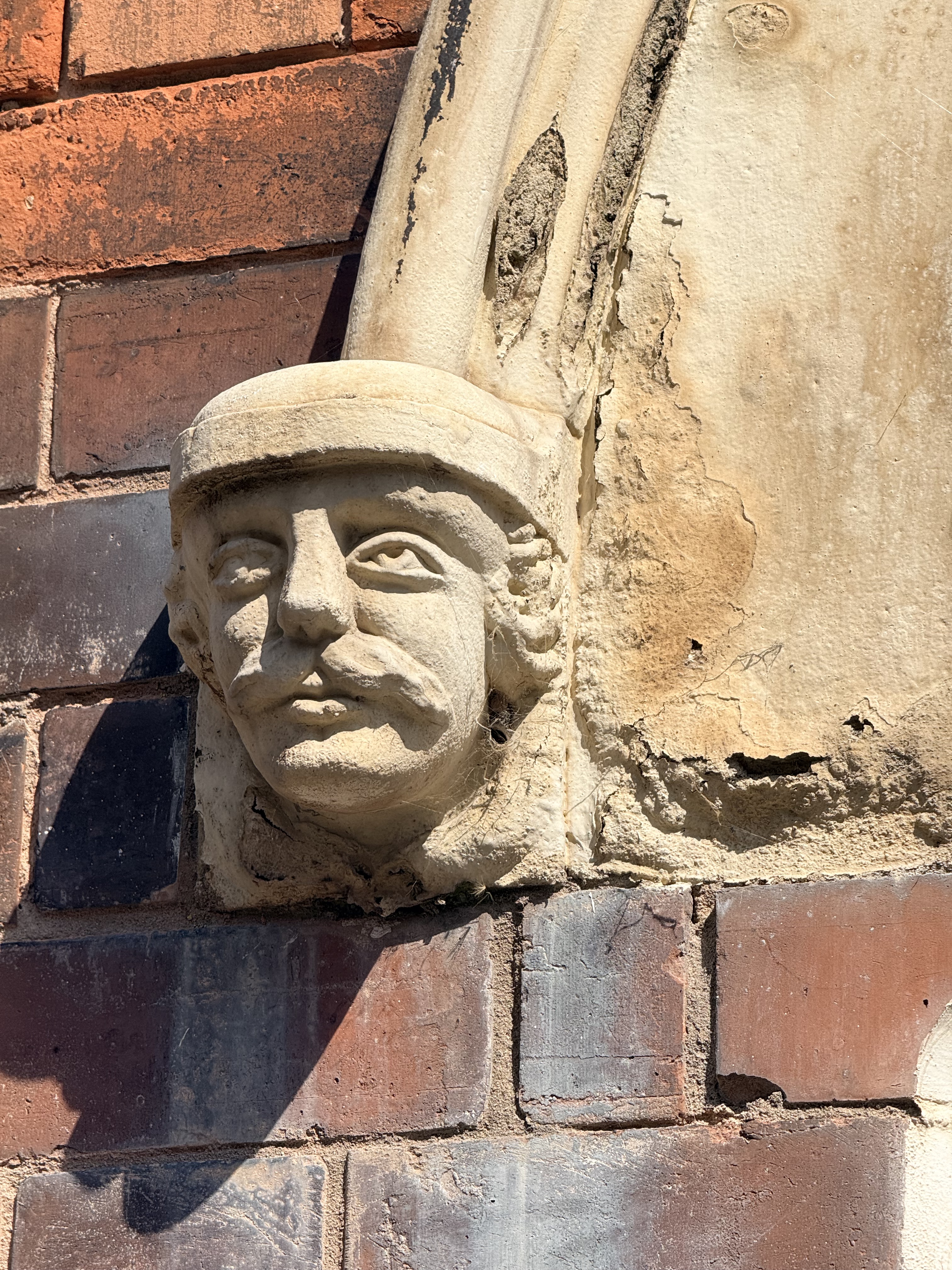
The street itself immediately triggered another memory though. The faces.

As a child I’d noticed many of the houses around here had human faces staring out from the stonework. They’re still there. Stern-looking carved heads tucked beneath the decorative stonework around front doors, apparently watching generations of Sneintonians go about their daily business.

I always wondered who they were. Kings? Local dignitaries? The people who built the houses? Particularly unfortunate former residents who had annoyed the architect?

It turns out I’m far from the first person to notice them. Sneinton has quite a collection of these carved heads and St. Stephen’s Road is apparently particularly well endowed with them. Some look vaguely like ancient warriors, others like rather severe Victorian interpretations of people from the past, but as far as I can establish there isn’t a neat answer to the question that occupied the younger me.

They’re just… faces.

Which is simultaneously disappointing and rather wonderful. They’ve probably been staring at children walking past whilst wondering who they were for considerably longer than I’ve been alive.

Sneinton itself looked surprisingly familiar too.

The Victorian streets remain. It still feels densely packed and bustling and proudly multicultural. The Asian community I remember from childhood is still very evident, particularly the Pakistani influence, but there are now Eastern European shops and businesses mixed amongst it too. Languages and people have changed while the streets containing them largely haven’t.

That’s perhaps what I found most interesting. Sneinton hasn’t really become somewhere else. It’s simply accumulated more Sneinton.

That isn’t to say nothing has changed. Slightly off my walking route is Sneinton Market, which has undergone a transformation that would have seemed utterly implausible to the younger me. Today it’s a fashionable little enclave of independent businesses, food, drink and creative spaces. This is emphatically not the Sneinton Market I remember.

My Sneinton Market was somewhere you went to buy something electrical for 99p while accepting there was a reasonable possibility it might stop being electrical before you got it home. For some reason I have a particularly vivid memory of headphones with orange foam earpieces. They were cheap, probably sounded dreadful and presumably survived until approximately Wednesday.

Nobody was drinking artisan coffee whilst I was buying them.

The funny thing about walking Sneinton today, though, is just how quickly the city starts to disappear.

Heading along the green route eastwards, tightly packed streets give way to twitchels and finally more open space and tree-lined footpaths until suddenly you’re in Colwick Country Park. It’s remarkably easy to forget how close the Trent Valley and all that greenery are to this part of inner Nottingham.

The park itself is comparatively young. It opened in the late 1970s after former gravel workings were landscaped, but the land you’re walking through has a much longer history. The wider estate around Colwick Hall stretches back centuries, and this was parkland long before anyone thought of creating a country park. That might explain one of the things I stumbled across.

In amongst the trees I found an old brick wall, smothered in ivy and pierced by what looks very much like a former gateway. There’s no grand building immediately behind it, no helpful plaque explaining what it once enclosed and nothing obvious to tell the passing walker why it’s there at all.

Naturally, I love this. Abandoned things and mystery. That’s very much my jam!

I don’t know exactly what it is. Given the history of the surrounding land, it may be a surviving fragment associated with the old Colwick Hall estate, but for now I’d rather leave a question mark beside it than manufacture a history simply because it would be convenient to have one. Sometimes finding something you can’t immediately explain is half the fun of wandering.

More annoyingly, I also discovered afterwards I’d walked agonisingly close to the abandoned St. John the Baptist church near Colwick Hall without realising it was there. Had I known, there is absolutely no possibility I’d have walked past it – that one is going onto the list for another day.

From Colwick Park my route eventually carried me over towards Bakersfield and back through Colwick Woods, somewhere I’ve already written about. This time the woods weren’t the destination, they were simply somewhere I happened to pass through on the way back to the car. Oddly, I quite liked that.

Having recently spent a chunk of time trogging around them for childhood memories, this time I could just walk through them again. They’d returned to being part of the landscape rather than a historical exhibit I’d constructed in my own head.

Then, eventually, Sneinton swallowed me again.

There was one more familiar landmark waiting near the end of the walk, although at the moment you’d be forgiven for not immediately recognising it.

Green’s Windmill is currently swaddled in white sheeting while maintenance work takes place, looking less like one of Nottingham’s most distinctive landmarks and more like somebody has put an enormous bag over it. Underneath all that material, though, is another place that reaches straight back into my childhood.

The windmill was another memorable if not regular haunt.

As children, of course, it was simply the windmill. Somewhere Mum or Dad could take us, somewhere you could look inside, look at the scientific exhibits in the museum or – more likely – decamp to the children’s play area and burn off excess energy. Only later do you discover that the place has a rather more remarkable story.

The original tower mill was built by George Green Sr in the early nineteenth century, and his son George worked there before becoming one of Nottingham’s more unlikely contributors to the history of science. With relatively little formal education, Green produced mathematical work on electricity and magnetism that was largely overlooked during his lifetime but would eventually become enormously influential. Today Green’s theorem and Green’s functions carry the name of a Nottingham miller’s son around the world.

Which makes the fact that I basically knew the place as somewhere that was fun to play with plasma balls or on the playground perhaps more than a little ignorant!

So next time you’re tempted to think disparaging thoughts about Sneinton, remember that one of the most important mathematical physicists of the nineteenth century emerged not from some grand academic institution, but from a miller’s family on a Nottingham hillside.

After the Greens, their mill had a rather eventful afterlife: falling out of use, losing its sails, suffering a fire and spending decades as an abandoned shell before being restored and reopened in the 1980s. Which isn’t far off when I first encountered it.

Perhaps that’s the thing I hadn’t appreciated about Sneinton when I was younger. I knew it as somewhere slightly rough around the edges where we went to judo. I knew the terraces, the Asian shops, the market selling questionably inexpensive electrical goods, the windmill on the hill and those mysterious stone faces staring down from the houses.

I hadn’t really noticed how many different landscapes and stories were squeezed together around it.

Within one walk I’d passed Victorian terraces, the ghosts of my old judo club, Pakistani and Eastern European shops, a country park, mysterious estate walls, lakes, the edge of an old country house, ancient woodland and the temporarily bagged up remains of a windmill that once belonged to a largely self-taught mathematical genius.

And yet somehow it all fits together.

As a kid I used to joke that Sneinton (Snenton, remember) sounded exactly like what it was. Walking around it again all these years later, I’m not entirely sure what I thought that meant. It’s untidy in places, of course. But it’s also colourful, busy, old, multicultural. Occasionally it’s beautiful, and occasionally perhaps lacking a bit of care. It has changed enormously in some ways, and hardly at all in others.

Perhaps the little stone faces opposite the old dojo on St. Stephen’s Road understand it better than I do.

They were there when I walked past them as a boy on my way to judo. The windmill was up on the hill. They’re both still there now, while the dojo has become flats, the market has discovered artisan food, new communities have arrived and I’ve somehow become the middle-aged bloke wandering around taking photographs of all of it.

I still don’t know who the faces are supposed to be.

But I do rather like the fact they’re still watching.

Categories: Blog, Exploring | Tags: , , , , , , , , , , , | Leave a comment

Blog at WordPress.com.