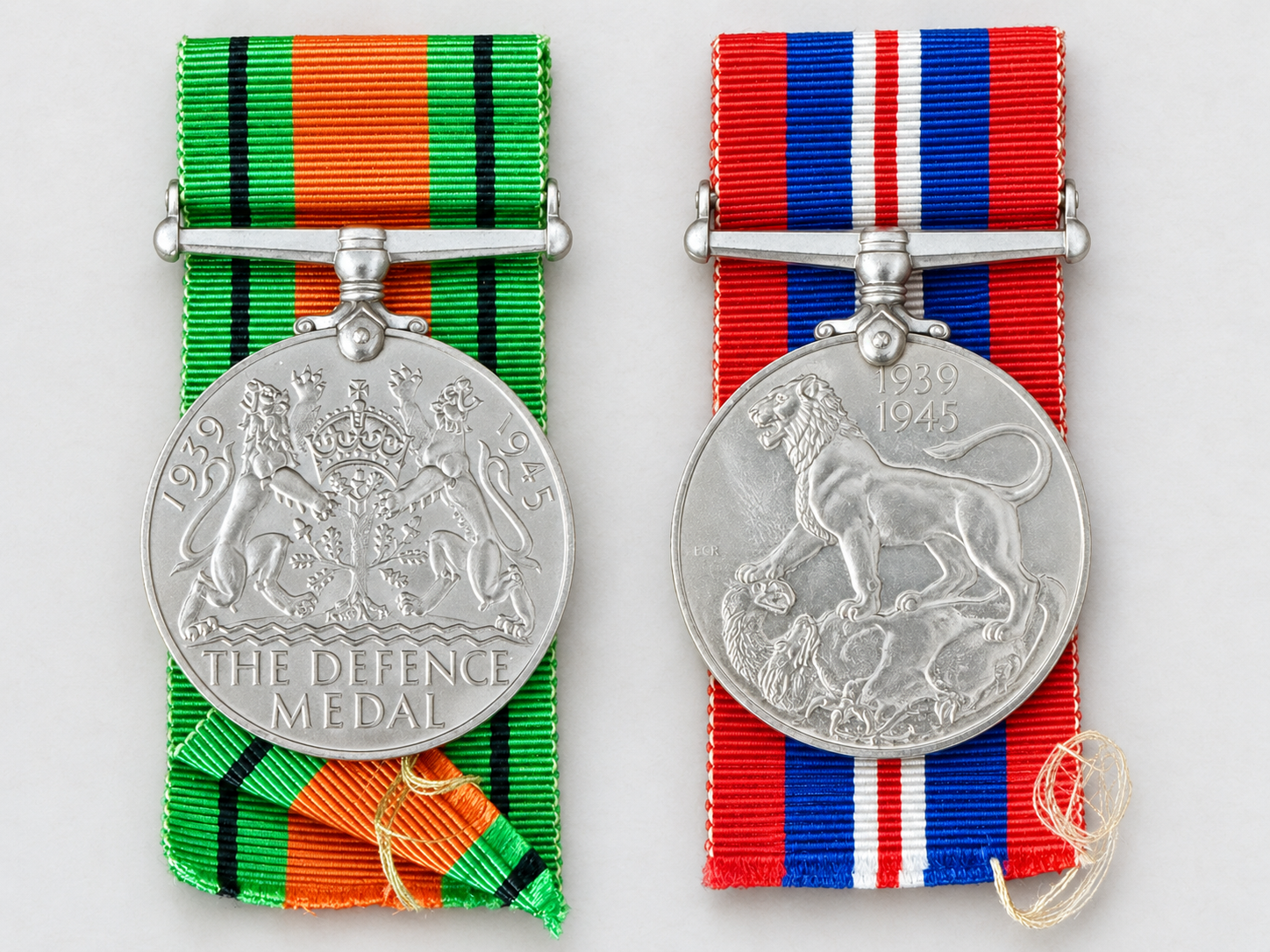
I have two of Mr Naylor’s medals.
He didn’t leave them to me. After he died, I found them among the things in his house after his belongings had been picked through by fairly distant relatives.
I couldn’t bear the thought of them simply disappearing. They were wrapped in waxed paper, tucked inside a small, battered cardboard box marked OHMS.
I knew they must have meant something to him.
So I kept them.
More than twenty years later, I found myself looking at them properly.
There are two: a Defence Medal and a War Medal 1939–45. Unlike the First World War medals I’d been looking at as part of some family-history research, neither has its recipient’s name stamped around the edge. But the box does have a name and address:
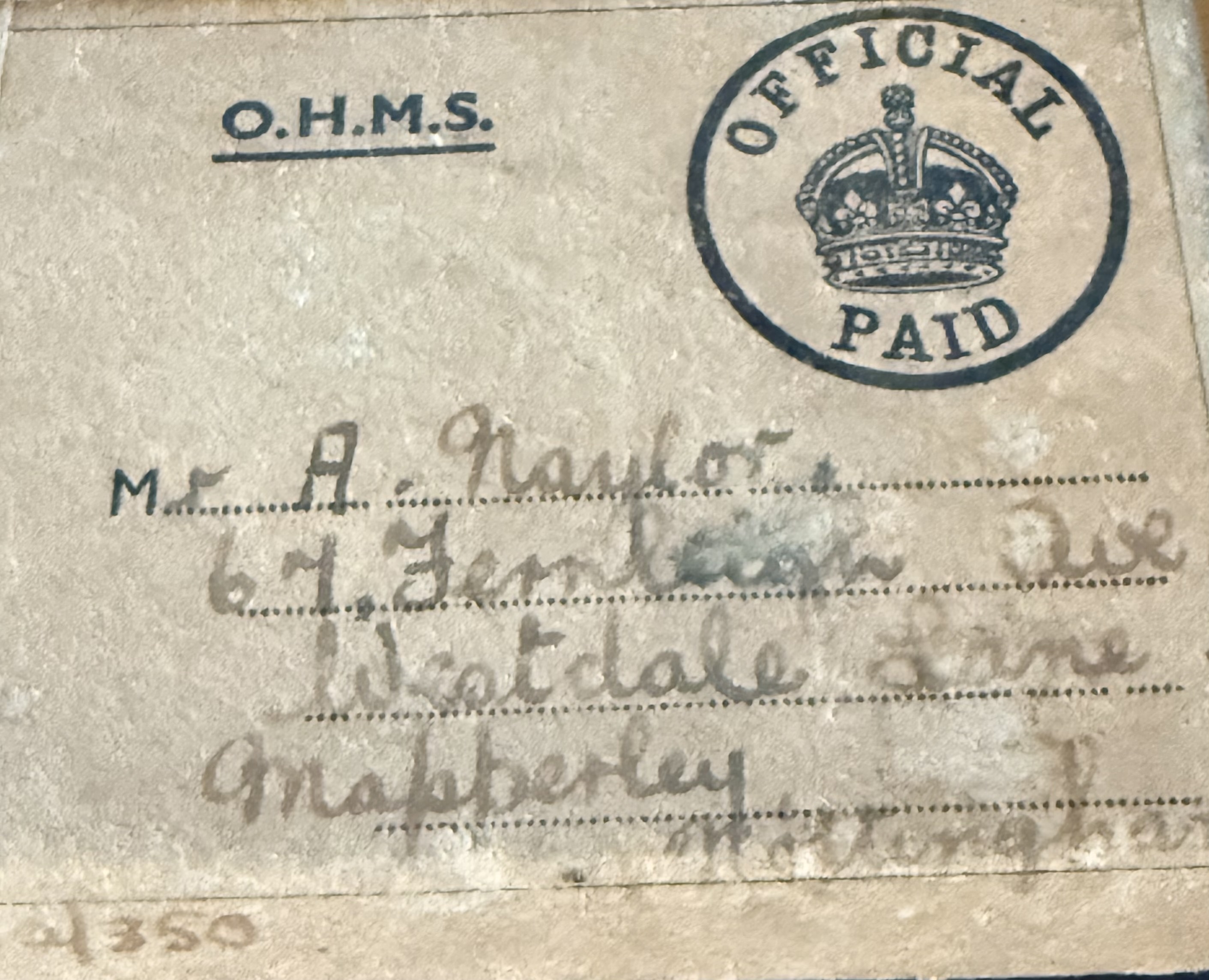
Mr A. Naylor
67 Fernleigh Ave
Westdale Lane
Mapperley
Nottingham
Which is odd.
Because Mr N lived at number 71.
Which naturally prompted some questions that I just can’t help trying to unpick.
We moved to Fernleigh Avenue when I was a child – probably around 8 years old – and my earliest memory of the Naylors involves a guinea pig.
Ours had escaped and, exercising the sort of navigational judgement you might expect from a guinea pig, had ended up next door.
Mrs Naylor was lovely. Larger than life, certainly compared with her husband, and wonderfully welcoming as we attempted to retrieve our fugitive pet from her garden.
Mr Naylor was much quieter.
In fact, in those earliest memories he was almost a supporting character to Mrs N. He was just Mr Naylor, although over the years that became shortened to Mr N.
I don’t think I even knew Mrs Naylor’s first name back then.
I do now.
She was Dorothy.
Dorothy Naylor died in 1988, which means it can’t have been very long after we moved to Fernleigh Avenue. And with her death something changed. Not immediately or dramatically, but the quieter half of the couple next door gradually became somebody we knew much better.
Mr N became a fixture.
He was a Derby County supporter, which was unfortunate given that he had moved into a Nottingham Forest-supporting household’s sphere of influence.
He particularly enjoyed asking about the football when Forest had not done very well. These enquiries were invariably delivered with an innocence that fooled nobody. His calm delivery belied a wicked sense of humour.
As it turns out, he had earned the right.
Mr N really was from Derbyshire.
His full name was Archibald Naylor, and he was born on Christmas Day, 1906.
That was something else I once knew and had forgotten. Mr N’s birthday was Christmas Day.
The records put his birthplace at Ilkeston. His father, Henry William Naylor, came from Loscoe and was a self-employed confectioner.
In 1921, Archie was fourteen.
This is where researching somebody you actually knew becomes slightly peculiar.
The Mr N of my memory is an old man. I can picture him perfectly well in his house next door. I can hear the mischievous enquiries about Forest. But until now I’d never had cause to imagine fourteen-year-old Archie Naylor.
He had a job.
He was an errand boy for a hairdresser called W. Annable.
There is something wonderful about discovering such a completely mundane fact about somebody decades after they died. I knew Mr N for years. I knew what football team he supported and what he thought constituted an adequate Sunday dinner.
I had absolutely no idea he’d once been a hairdresser’s errand boy.
By 1935 he’d moved into another phase of his life. Archie married Dorothy Shephard that year.
Four years later, the 1939 Register finds them together on Fernleigh Avenue. I suspect they may have moved there as newlyweds, possibly even into a newly built house, although that’s one part of the story I haven’t yet managed to prove.
Archibald Naylor, born 25 December 1906.
Dorothy Naylor, born 26 September 1902.
Both had the same occupation:
Hosiery cutter.
Perhaps that’s how they met.
I don’t know that, and records can’t tell us. Nottingham and its surrounding towns were built on hosiery, so two people working in the industry finding one another was hardly remarkable.
But I like the possibility.
What we can say is that in 1939 the young Mr and Mrs N weren’t at number 71.
They were at 57 Fernleigh Avenue.
At some later point Mr N’s address was number 67, because that’s where his wartime medals were sent. By the time I knew him, it was 71.
Fernleigh Avenue was still developing around them, with new houses appearing and numbering changing. Exactly when those numbers changed — and whether every change represents renumbering rather than a move a few doors along — is something I haven’t quite untangled yet, I’m pretty sure they never moved house though.
But the little cardboard medal box suddenly made something I’d never thought about before visible.
Mr N had been on Fernleigh Avenue for a very long time.
The medals themselves raise more questions than they answer.
The two I have are the Defence Medal and the War Medal 1939–45.
I have a vague recollection that Mr N’s war was spent at home, perhaps in something akin to the Home Guard. I certainly don’t remember him talking about serving overseas.
But memory isn’t evidence, and I don’t know.
That’s one of the strange things about this exercise.
Why didn’t I ask him?
The obvious answer is that I was a child and then a teenager, and Mr N was an old man who lived next door. Although, like plenty of teenage boys, I went through at least a passing obsession with the war, which makes it slightly surprising that I never thought to ask.
People don’t generally introduce themselves to children with an eighty-year autobiography.
And when somebody is part of your everyday life, you tend to know them in the present tense.
Mr N was simply Mr N.
His lounge had decorative plates on the wall depicting Bill Sikes and Fagin. I remember those.
He had an elephant door knocker. I remember that too. In fact, the elephant survived him, migrating next door and spending its retirement in the garden room at Mum and Dad’s.
I remember his football team.
I remember his dinners.
I don’t remember ever asking what he’d done to earn the medals.
As he got older, Mr N increasingly relied on Meals on Wheels.
There was, however, a flaw in the system.
They didn’t deliver on Sundays.
So Mum started plating up an extra Sunday dinner and we’d take it round to him.
The first time we did this, Mr N inspected what we’d brought and asked about pudding.
We didn’t habitually have pudding.
This apparently constituted a serious failure in the service we were providing.
Mum frantically improvised something.
Thereafter, we had pudding on Sundays.
Thanks, Mr N.
Eventually somebody reached the fairly obvious conclusion that if we were cooking Mr N a Sunday dinner anyway, carrying it next door was unnecessarily complicated.
So instead of dinner going to Mr N, Mr N came to dinner.
And then Christmas.
I hadn’t thought until doing this research about the fact that every Christmas Mr N spent with us was also his birthday.
Christmas Day 1906.
I must once have known that. Perhaps we even marked it at the time. But it had disappeared somewhere into the enormous collection of things you once knew and didn’t realise you’d forgotten.
The record gave it back to me.
There was one occasion when I got home from school before Mum and Dad.
The phone rang.
It was Mr N.
He wasn’t very well.
I was old enough to understand that something needed doing, so after popping over to him and finding him struggling, I called an ambulance.
Unfortunately I wasn’t quite smart enough to reliably calculate which direction house numbers went.
We lived at number 69. Mr N lived next door, so in my youthful wisdom I subtracted two and confidently told the emergency services operative that he was at number 67.
He wasn’t.
He was at 71.
Mr N, despite being ill enough that I’d just summoned an ambulance for him, had to correct me.
I find that particularly funny now.
Because sitting in front of me today is a cardboard box addressed:
Mr A. Naylor
67 Fernleigh Avenue.
I was right.
Just several decades too late.
Archibald Naylor died in the first few months of 2004.
He was 97 years old.
That number surprised me even though I knew he’d been well into his nineties. Ninety-seven years is an enormous amount of life.
And what follows is an almost comically inadequate summary of one.
He had been born before the First World War.
At fourteen he ran errands for a hairdresser.
He married Dorothy in 1935.
They cut hosiery for a living.
He lived through another world war and undertook some form of service during it, although I still don’t know exactly what.
He spent decades with Dorothy.
He lost her in 1988 and lived another sixteen years without her.
And that’s about it.
Ninety-seven years compressed into a handful of facts gathered from forms filled in decades apart.
I don’t know what Archie was doing on his twentieth birthday. I don’t know where he and Dorothy went on their first date, or whether they had one. I don’t know what they did on Saturday nights, where they went on holiday, what frightened them, what they argued about, or what made them laugh.
I don’t even know what he did during a world war whose medals are sitting on the desk in front of me.
But I do know that, much later, he expected pudding with his Sunday dinner.
And perhaps that’s the strange bargain between records and memory.
The records can tell me things about Mr N that I never knew. They can introduce me to Archie: the Derbyshire boy, the fourteen-year-old hairdresser’s errand runner, the hosiery cutter, Dorothy’s new husband, the man already living on Fernleigh Avenue before the Second World War had begun.
But the records don’t know about the Bill Sikes and Fagin plates.
They don’t know about the elephant door knocker.
There is no box on the 1939 Register for enjoyed enquiring about Nottingham Forest after a defeat.
And nowhere in the official record of the life of Archibald Naylor will it say that an elderly widower once asked where his pudding was and consequently changed the Sunday dining habits of the family next door.
Those are the bits we get to keep.
Between the records and the memories, perhaps we can see a little more of him than either could preserve alone.
Not a 97-year life. Not even close.
Just fragments of one.
For more than twenty years, two of those fragments have been sitting in a little cardboard box.
I kept Mr N’s medals because I knew they mattered to him. I still don’t know exactly why.
But they made me curious enough to ask.
And perhaps that’s what telling somebody’s story really amounts to.
Not recovering everything.
Just making sure that a little more of them survives.


Recent Comments