Posts Tagged With: musings

Who lives, who dies, who tells your story?

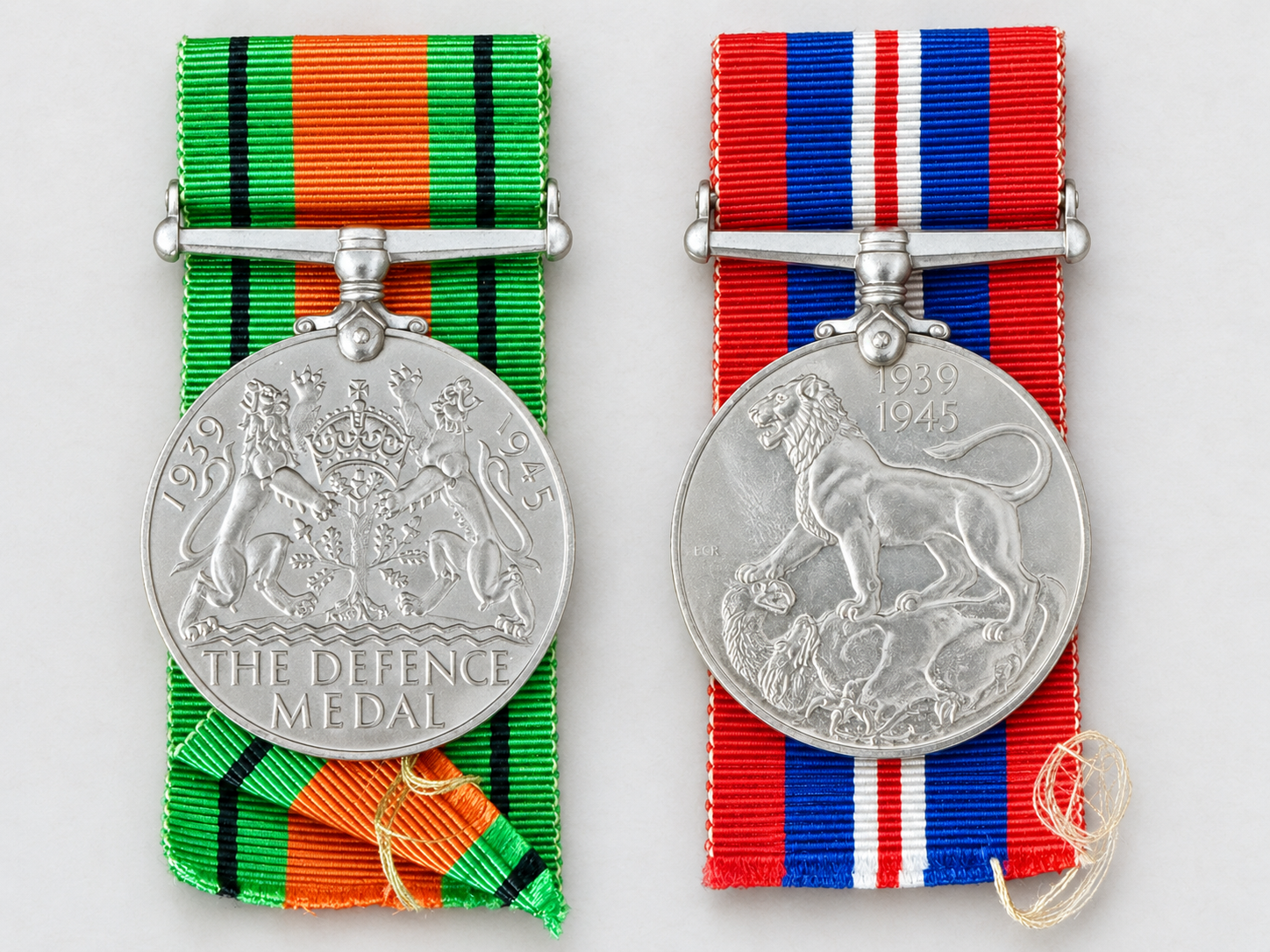
I have two of Mr Naylor’s medals.

He didn’t leave them to me. After he died, I found them among the things in his house after his belongings had been picked through by fairly distant relatives.

I couldn’t bear the thought of them simply disappearing. They were wrapped in waxed paper, tucked inside a small, battered cardboard box marked OHMS.

I knew they must have meant something to him.

So I kept them.

More than twenty years later, I found myself looking at them properly.

There are two: a Defence Medal and a War Medal 1939–45. Unlike the First World War medals I’d been looking at as part of some family-history research, neither has its recipient’s name stamped around the edge. But the box does have a name and address:
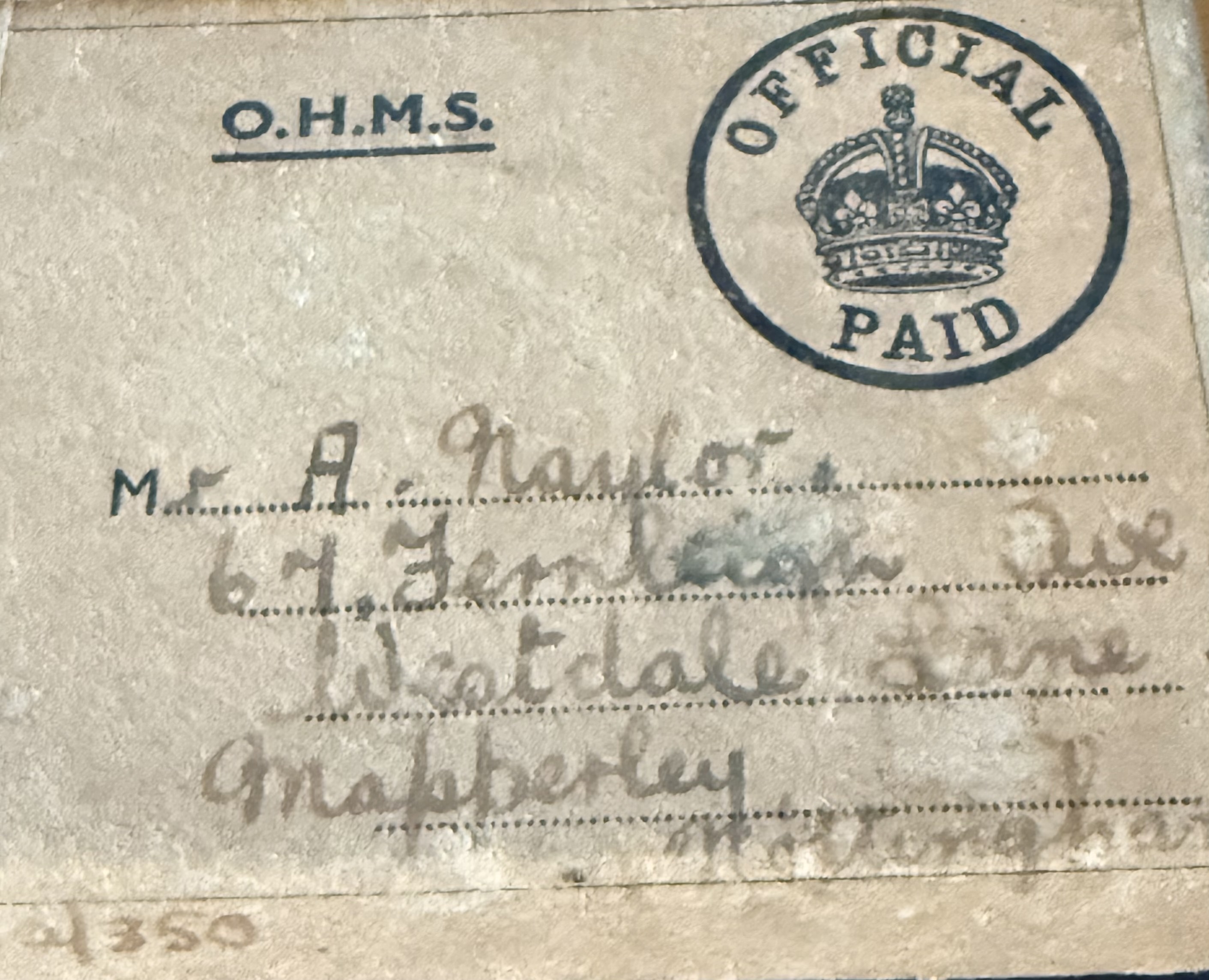
Mr A. Naylor
67 Fernleigh Ave

Westdale Lane
Mapperley
Nottingham

Which is odd.

Because Mr N lived at number 71.

Which naturally prompted some questions that I just can’t help trying to unpick.

We moved to Fernleigh Avenue when I was a child – probably around 8 years old – and my earliest memory of the Naylors involves a guinea pig.

Ours had escaped and, exercising the sort of navigational judgement you might expect from a guinea pig, had ended up next door.

Mrs Naylor was lovely. Larger than life, certainly compared with her husband, and wonderfully welcoming as we attempted to retrieve our fugitive pet from her garden.

Mr Naylor was much quieter.

In fact, in those earliest memories he was almost a supporting character to Mrs N. He was just Mr Naylor, although over the years that became shortened to Mr N.

I don’t think I even knew Mrs Naylor’s first name back then.

I do now.

She was Dorothy.

Dorothy Naylor died in 1988, which means it can’t have been very long after we moved to Fernleigh Avenue. And with her death something changed. Not immediately or dramatically, but the quieter half of the couple next door gradually became somebody we knew much better.

Mr N became a fixture.

He was a Derby County supporter, which was unfortunate given that he had moved into a Nottingham Forest-supporting household’s sphere of influence.

He particularly enjoyed asking about the football when Forest had not done very well. These enquiries were invariably delivered with an innocence that fooled nobody. His calm delivery belied a wicked sense of humour.

As it turns out, he had earned the right.

Mr N really was from Derbyshire.

His full name was Archibald Naylor, and he was born on Christmas Day, 1906.

That was something else I once knew and had forgotten. Mr N’s birthday was Christmas Day.

The records put his birthplace at Ilkeston. His father, Henry William Naylor, came from Loscoe and was a self-employed confectioner.

In 1921, Archie was fourteen.

This is where researching somebody you actually knew becomes slightly peculiar.

The Mr N of my memory is an old man. I can picture him perfectly well in his house next door. I can hear the mischievous enquiries about Forest. But until now I’d never had cause to imagine fourteen-year-old Archie Naylor.

He had a job.

He was an errand boy for a hairdresser called W. Annable.

There is something wonderful about discovering such a completely mundane fact about somebody decades after they died. I knew Mr N for years. I knew what football team he supported and what he thought constituted an adequate Sunday dinner.

I had absolutely no idea he’d once been a hairdresser’s errand boy.

By 1935 he’d moved into another phase of his life. Archie married Dorothy Shephard that year.

Four years later, the 1939 Register finds them together on Fernleigh Avenue. I suspect they may have moved there as newlyweds, possibly even into a newly built house, although that’s one part of the story I haven’t yet managed to prove.

Archibald Naylor, born 25 December 1906.

Dorothy Naylor, born 26 September 1902.

Both had the same occupation:

Hosiery cutter.

Perhaps that’s how they met.

I don’t know that, and records can’t tell us. Nottingham and its surrounding towns were built on hosiery, so two people working in the industry finding one another was hardly remarkable.

But I like the possibility.

What we can say is that in 1939 the young Mr and Mrs N weren’t at number 71.

They were at 57 Fernleigh Avenue.

At some later point Mr N’s address was number 67, because that’s where his wartime medals were sent. By the time I knew him, it was 71.

Fernleigh Avenue was still developing around them, with new houses appearing and numbering changing. Exactly when those numbers changed — and whether every change represents renumbering rather than a move a few doors along — is something I haven’t quite untangled yet, I’m pretty sure they never moved house though.

But the little cardboard medal box suddenly made something I’d never thought about before visible.

Mr N had been on Fernleigh Avenue for a very long time.

The medals themselves raise more questions than they answer.

The two I have are the Defence Medal and the War Medal 1939–45.

I have a vague recollection that Mr N’s war was spent at home, perhaps in something akin to the Home Guard. I certainly don’t remember him talking about serving overseas.

But memory isn’t evidence, and I don’t know.

That’s one of the strange things about this exercise.

Why didn’t I ask him?

The obvious answer is that I was a child and then a teenager, and Mr N was an old man who lived next door. Although, like plenty of teenage boys, I went through at least a passing obsession with the war, which makes it slightly surprising that I never thought to ask.

People don’t generally introduce themselves to children with an eighty-year autobiography.

And when somebody is part of your everyday life, you tend to know them in the present tense.

Mr N was simply Mr N.

His lounge had decorative plates on the wall depicting Bill Sikes and Fagin. I remember those.

He had an elephant door knocker. I remember that too. In fact, the elephant survived him, migrating next door and spending its retirement in the garden room at Mum and Dad’s.

I remember his football team.

I remember his dinners.

I don’t remember ever asking what he’d done to earn the medals.

As he got older, Mr N increasingly relied on Meals on Wheels.

There was, however, a flaw in the system.

They didn’t deliver on Sundays.

So Mum started plating up an extra Sunday dinner and we’d take it round to him.

The first time we did this, Mr N inspected what we’d brought and asked about pudding.

We didn’t habitually have pudding.

This apparently constituted a serious failure in the service we were providing.

Mum frantically improvised something.

Thereafter, we had pudding on Sundays.

Thanks, Mr N.

Eventually somebody reached the fairly obvious conclusion that if we were cooking Mr N a Sunday dinner anyway, carrying it next door was unnecessarily complicated.

So instead of dinner going to Mr N, Mr N came to dinner.

And then Christmas.

I hadn’t thought until doing this research about the fact that every Christmas Mr N spent with us was also his birthday.

Christmas Day 1906.

I must once have known that. Perhaps we even marked it at the time. But it had disappeared somewhere into the enormous collection of things you once knew and didn’t realise you’d forgotten.

The record gave it back to me.

There was one occasion when I got home from school before Mum and Dad.

The phone rang.

It was Mr N.

He wasn’t very well.

I was old enough to understand that something needed doing, so after popping over to him and finding him struggling, I called an ambulance.

Unfortunately I wasn’t quite smart enough to reliably calculate which direction house numbers went.

We lived at number 69. Mr N lived next door, so in my youthful wisdom I subtracted two and confidently told the emergency services operative that he was at number 67.

He wasn’t.

He was at 71.

Mr N, despite being ill enough that I’d just summoned an ambulance for him, had to correct me.

I find that particularly funny now.

Because sitting in front of me today is a cardboard box addressed:

Mr A. Naylor
67 Fernleigh Avenue.

I was right.

Just several decades too late.

Archibald Naylor died in the first few months of 2004.

He was 97 years old.

That number surprised me even though I knew he’d been well into his nineties. Ninety-seven years is an enormous amount of life.

And what follows is an almost comically inadequate summary of one.

He had been born before the First World War.

At fourteen he ran errands for a hairdresser.

He married Dorothy in 1935.

They cut hosiery for a living.

He lived through another world war and undertook some form of service during it, although I still don’t know exactly what.

He spent decades with Dorothy.

He lost her in 1988 and lived another sixteen years without her.

And that’s about it.

Ninety-seven years compressed into a handful of facts gathered from forms filled in decades apart.

I don’t know what Archie was doing on his twentieth birthday. I don’t know where he and Dorothy went on their first date, or whether they had one. I don’t know what they did on Saturday nights, where they went on holiday, what frightened them, what they argued about, or what made them laugh.

I don’t even know what he did during a world war whose medals are sitting on the desk in front of me.

But I do know that, much later, he expected pudding with his Sunday dinner.

And perhaps that’s the strange bargain between records and memory.

The records can tell me things about Mr N that I never knew. They can introduce me to Archie: the Derbyshire boy, the fourteen-year-old hairdresser’s errand runner, the hosiery cutter, Dorothy’s new husband, the man already living on Fernleigh Avenue before the Second World War had begun.

But the records don’t know about the Bill Sikes and Fagin plates.

They don’t know about the elephant door knocker.

There is no box on the 1939 Register for enjoyed enquiring about Nottingham Forest after a defeat.

And nowhere in the official record of the life of Archibald Naylor will it say that an elderly widower once asked where his pudding was and consequently changed the Sunday dining habits of the family next door.

Those are the bits we get to keep.

Between the records and the memories, perhaps we can see a little more of him than either could preserve alone.

Not a 97-year life. Not even close.

Just fragments of one.

For more than twenty years, two of those fragments have been sitting in a little cardboard box.

I kept Mr N’s medals because I knew they mattered to him. I still don’t know exactly why.

But they made me curious enough to ask.

And perhaps that’s what telling somebody’s story really amounts to.

Not recovering everything.

Just making sure that a little more of them survives.
Categories: Blog | Tags: , , , , , | 1 Comment

One Step Left of Limelight

Title irresistibly pilfered from the excellent Gaz Brookfield’s ‘Limelight’

I’ve always hated the term “Hell Hounds”.

For the uninitiated, it’s a name adopted by some of the more dedicated followers of Ferocious Dog. There’s absolutely nothing wrong with it. People like belonging to things, people like having names for the things they belong to, and if calling yourself a Hell Hound makes you happy then you should absolutely crack on.

But it makes me cringe.

Worse still is anything along the lines of “a proper Hell Hound would…” or “all Hell Hounds think…”

Ugh.

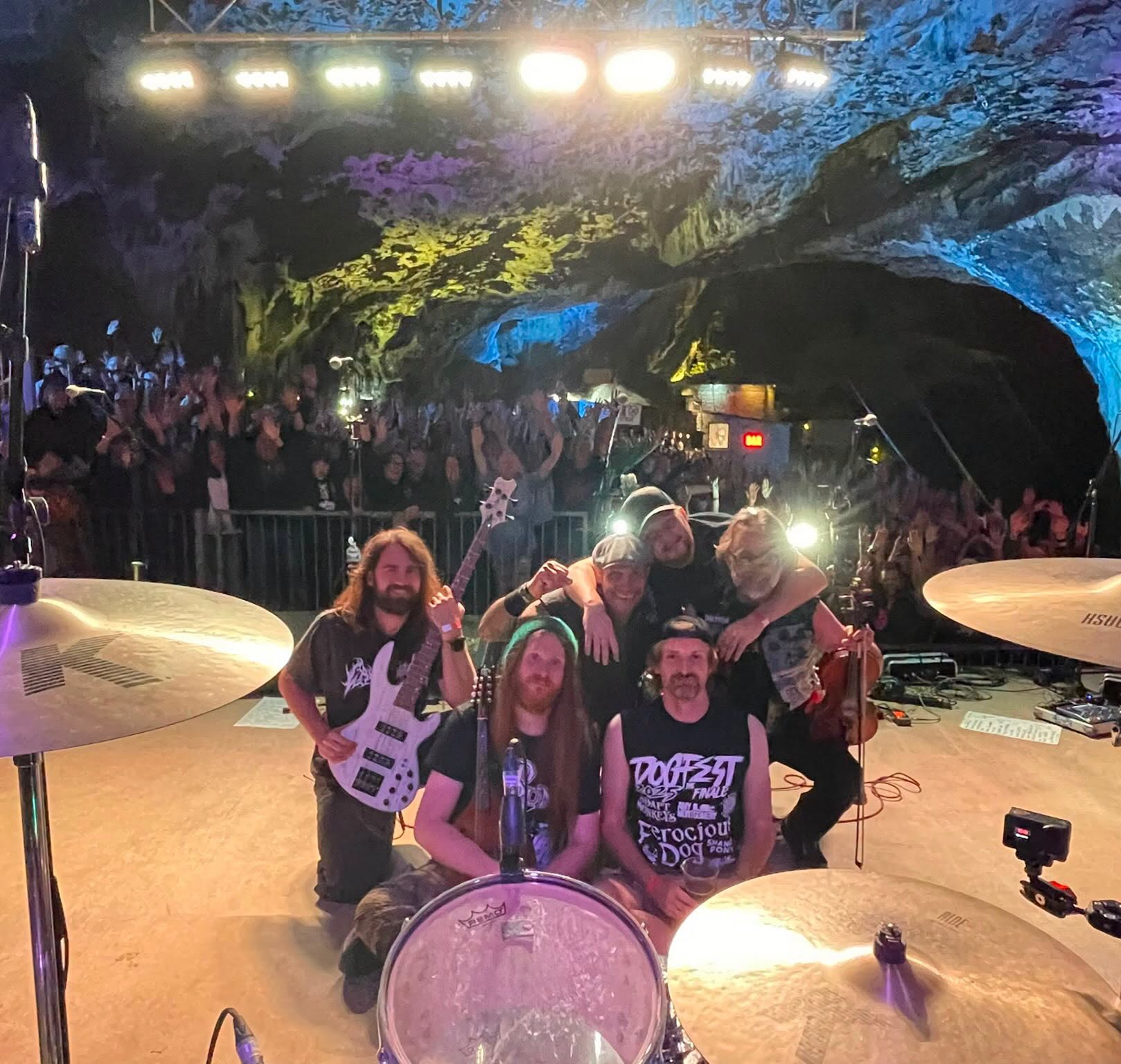
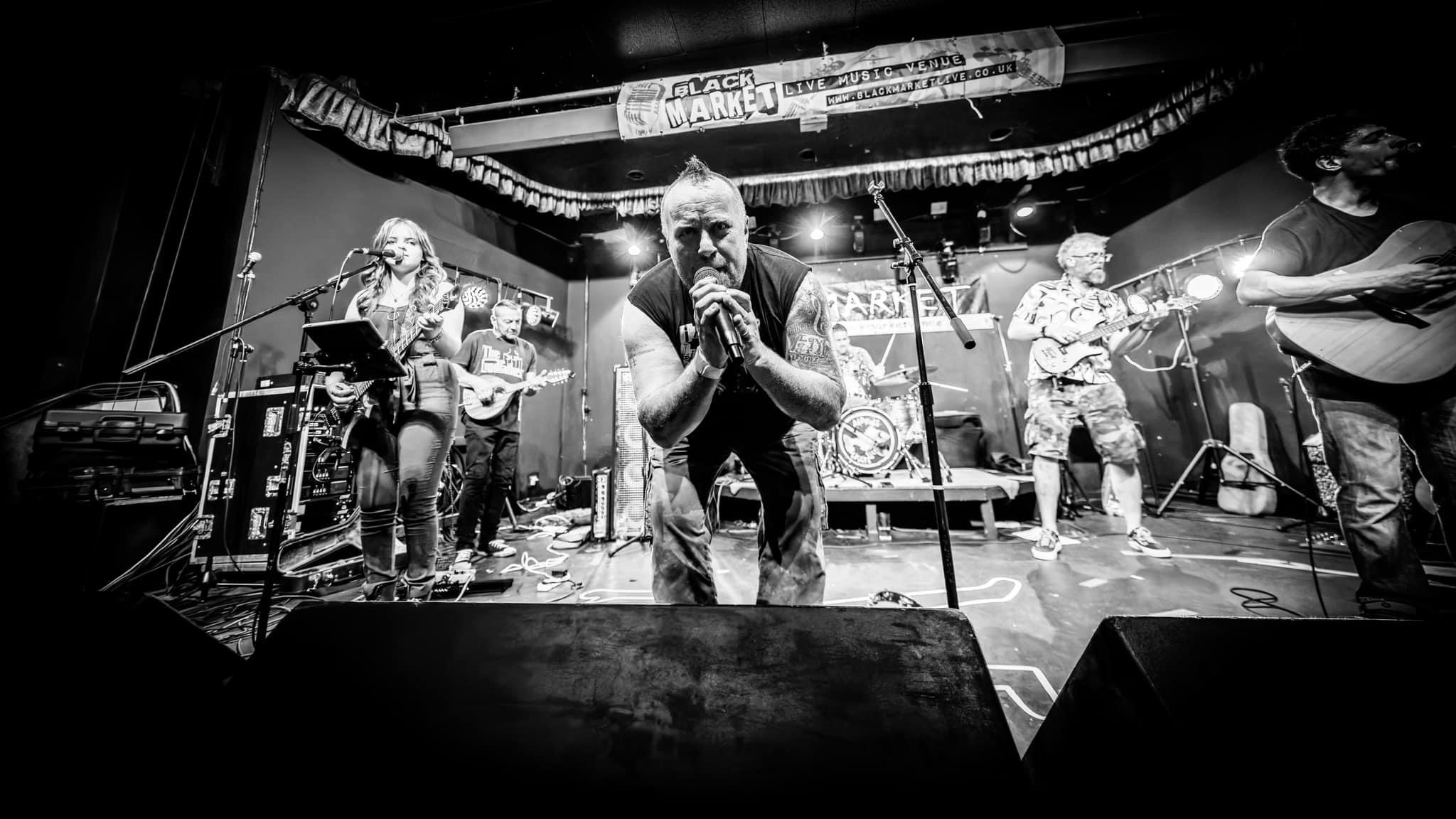
The early days: lots of familiar faces, ridiculous amounts of travelling and a community I was very happily part of – whatever anybody wanted to call us.

A warning before we go any further: this is going to be an unusually self-indulgent post.

Most things I write here might start with me, but generally wander off fairly quickly towards a place, a memory, a bit of history or whatever other rabbit hole has caught my attention. This one is, unapologetically, about me. Almost entirely.

I’ve recently been rummaging through an extraordinary amount of detritus left behind by younger versions of myself – old fanzines, university records, ancient websites, forum posts and blogs – and somewhere along the way I realised I’d inadvertently assembled something approaching a thirty-year archive of how I thought, what interested me and where I chose to spend my time.

So naturally, rather than doing anything sensible with this information, I decided to conduct an amateur psychological investigation into myself.

What could possibly go wrong?

The starting point for this particular bout of navel-gazing was something I’d previously filed away as just another one of my quirks.

Why does something as innocuous as “Hell Hounds” irritate me quite so much?

And in trying to answer that, I stumbled into a much bigger question about something I’ve done for most of my life.

I’m not sure I’m very good at belonging.

Which probably sounds ridiculous to anybody who knows me.

I’ve spent huge chunks of my life immersed in communities. As a teenager I was involved with my brother’s Nottingham Forest fanzine, Forest Forever. Later I helped establish the Lost That Loving Feeling forum and became part of the community that grew around it. I wrote anonymously about Forest for years on another blog. As football gradually became less important to me, music increasingly took its place and I spent years travelling around the country and beyond watching Ferocious Dog, started Ferocious Blog, acquired another sprawling collection of friends, a life partner, and eventually even ended up playing in a band myself.

Alongside all of that, in various incarnations, domains and bits of increasingly obsolete internet technology, I’ve maintained a personal website or blog for most of my adult life.

So I’m hardly a hermit.

And yet there’s a pattern here that goes back much further than any of those things.

Clique hopping

At secondary school I was a serial clique-hopper.

I had friends in lots of different groups without ever feeling completely embedded in one. I probably never fully penetrated the genuinely cool groups, and certainly not the particularly sporty ones, but I was generally on good terms with them. I could move between groups reasonably comfortably.

At the time I don’t remember thinking there was anything significant about this. Why would I? They were just my friends.

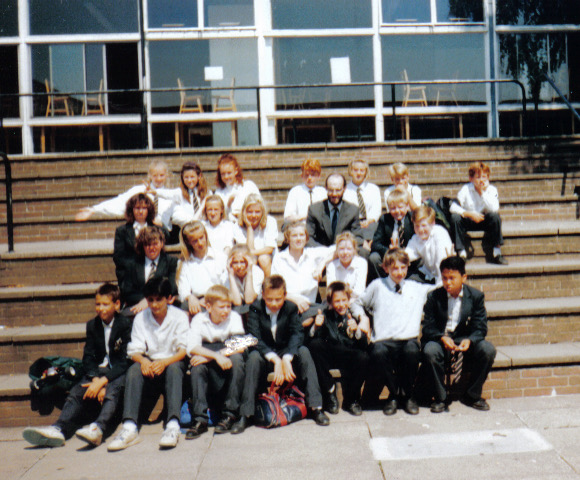
Exhibit A: My secondary school tutor group. I’d intended this to illustrate my teenage clique-hopping, until I noticed I wasn’t in the photograph, I was outside the group documenting it from behind a camera. Of course I was.

Looking back, though, I’ve sometimes wondered whether there was a strategy buried in there that I didn’t consciously understand.

If you’re friendly with everybody but never invest your entire social identity in one group, nobody can completely reject you.

Was that what I was doing?

I genuinely don’t know.

There’s an obvious danger when rummaging around inside your own childhood from the vantage point of several decades later. Memories aren’t data, and it’s remarkably easy to retrofit an elegant explanation onto behaviour that was actually just a teenager wandering around talking to whoever happened to be there.

But the pattern didn’t entirely disappear.

I’ve continued to move quite comfortably between groups of people throughout my life. I can become heavily involved with a community without ever quite planting a flag and thinking: these are my people; this is where I belong.

Or perhaps that isn’t quite right either.

Maybe I don’t have a problem belonging.

Maybe I have a problem claiming that I belong.

Know your place

I notice it particularly around people who attract attention.

If I know somebody who happens to have a crowd of people wanting to speak to them, I will almost invariably concede the space.

There are perfectly reasonable motives for that. I’ve probably had plenty of opportunities to talk to them before. The person waiting might not have. Their time isn’t mine to monopolise.

But if I’m being completely truthful, there’s another calculation going on too.

Who am I to assume they particularly want to talk to me?

And perhaps even more revealingly: I absolutely do not want the people around them to think I’m hanging around simply because they’re somebody worth hanging around.

Which can create the slightly ridiculous situation where my relationship with somebody is being influenced by the imagined judgement of complete strangers who know neither of us.

To assert I actually know this person feels hideously self-important, even when it is simply an unremarkable statement of fact.

So I tend to step back.

The other person may not be conducting any of these calculations whatsoever. They might simply see me and think, there’s Al.

Meanwhile I’ve convened a committee meeting in my head to establish whether I have sufficient standing to say hello.

A proper Hell Hound

Which brings me back to those bloody Hell Hounds.

I don’t actually dislike communities. The evidence against that proposition would be overwhelming. I’ve spent much of my life joining them, helping to create them and documenting them in frankly unnecessary levels of detail.

What I really dislike, I think, is what can happen when membership becomes an identity and the identity starts acquiring rules.

A proper fan would…

People like us think…

You can’t call yourself a real supporter if…

Something inside me immediately responds:

Who the fuck put you in charge?

This turns out not to be an entirely unexplored psychological phenomenon.

In 1991, psychologist Marilynn Brewer proposed Optimal Distinctiveness Theory. In extremely simplified terms, it describes a tension between two social needs: we want inclusion and belonging, but we also want to retain our individuality. We therefore negotiate a comfortable distance between being part of the group and being swallowed by it.

That struck a chord.

I want to be able to love a band without having to love every record they make. I want to disagree with other fans without having my credentials checked. I don’t care how many gigs somebody has attended, whether they were there “before they got big”, whether they know members of the band or whether they bought the limited-edition commemorative tea towel.

And I certainly don’t think doing any of those things gives me the right to tell somebody else how they should enjoy the same thing.

Belonging is fine.

Terms and conditions apply? Not so much.

An accidental longitudinal study

The problem with amateur self-analysis is that it’s incredibly easy to talk yourself into whatever conclusion appeals to you.

Fortunately – or perhaps unfortunately – I have something most people don’t have when attempting to work out whether they’ve behaved consistently over several decades.

I have an absolutely ludicrous amount of evidence.

I have been leaving bits of myself lying around on paper and the internet since I was a teenager.

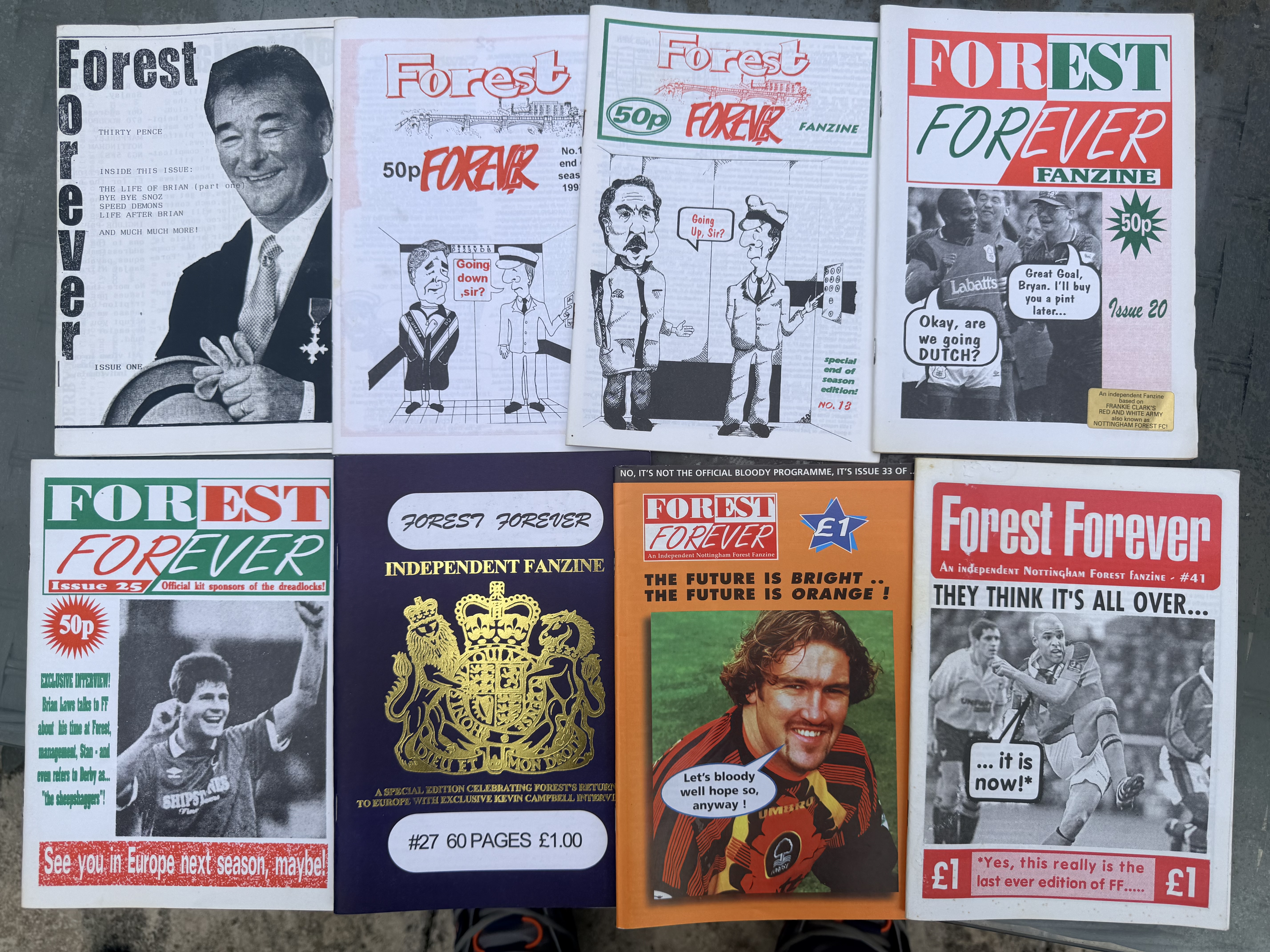
There are forty-one issues of Forest Forever in a box in the shed. There are old websites, forum posts, cartoons, abandoned domains, blogs, comments and articles. Some were written under my own name, some under usernames and one entire Forest blog was deliberately written anonymously.

Exhibit B: Forest Forever, from Issue 1 to Issue 41. Apparently I’ve been leaving evidence for the prosecution since the early 1990s.

My personal website has existed in one form or another throughout most of it, quietly accumulating whatever happened to interest me at the time.

More recently I’ve been digging through some of this detritus.

It’s an odd experience.

Normally when we remember our younger selves, we do so through the filter of everything that has happened since. I can tell you what I think I was like at 30.

But occasionally I can also ask 30-year-old me.

And he left several thousand words explaining himself.

The superficial story is one I’ve sometimes been slightly unkind to myself about.

I flit.

Forest Forever ends. Later there’s LTLF. Then an anonymous Forest blog. Then Ferocious Blog. Subjects change, platforms change, communities change.

There he goes again.

Another enthusiasm. Another project.

Can’t stick at anything.

Except the closer I’ve looked, the less convincing that interpretation has become.

Forest Forever largely ended because my brother went away to university. My first significant withdrawal from football coincided with the teenage discovery that girls were considerably more interesting than Nottingham Forest. My later disenchantment with Forest coincided both with increasing unhappiness about football and the club’s ownership and with music becoming an increasingly important part of my life.

Ferocious Blog eventually slowed down for different reasons again. Its original purpose – essentially to shout Ferocious Dog are brilliant and you should probably go and see them – became increasingly redundant as rather more people started doing exactly that. Covid disrupted the social world around it, the crowds grew, familiar faces became less ubiquitous and my own relationship with the band and scene changed.

Meanwhile I hadn’t stopped writing.

The personal blog was there throughout almost all of it.

It never really had a purpose, which might be precisely why it survived.

Same bloke, different subject

Something else became apparent while reading the old material.

The subjects change considerably.

The person writing about them rather less so.

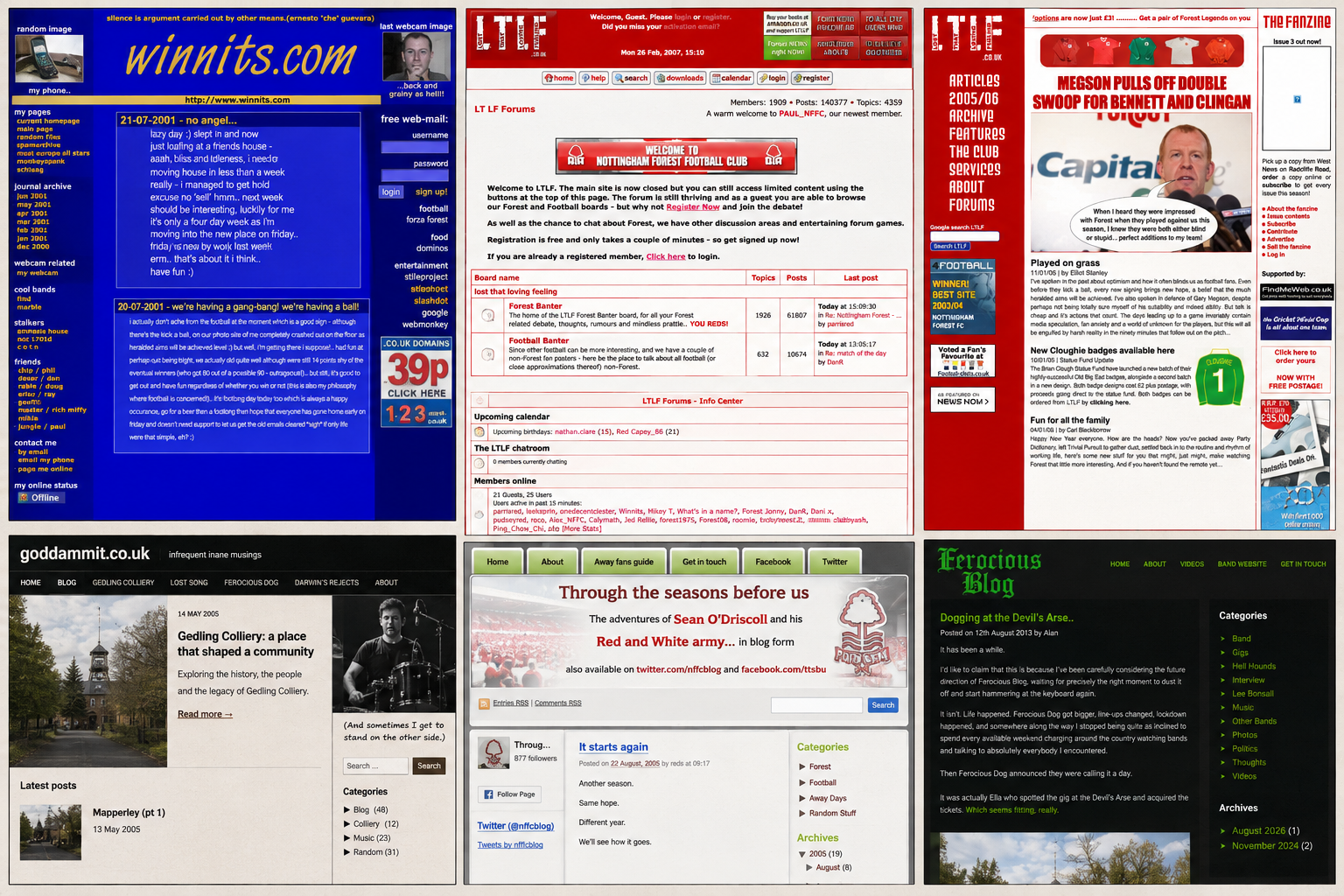
Exhibit C: actually quite selective different websites, different subjects, different centuries in web design. Annoyingly, much the same bloke behind them.

My anonymous Forest blog contains endless examples of me worrying away at group consensus. Why has everybody decided this manager is an idiot? What do we actually know about this owner? Why are we assuming that player is motivated by greed? Where did this rumour come from? Why has everybody repeated it until it became true? Why does disagreement online so rapidly turn into abuse?

At the time I thought I was writing about Nottingham Forest.

Reading it years later, there’s an awful lot about crowds, identity, conformity, communication and the way groups construct their own versions of reality.

Then I wandered away from football and started writing about music.

Different subject.

Many of the same preoccupations.

Who belongs? Who decides? What makes somebody authentic? How do relationships change as a community grows? What happens when a loose collection of people starts acquiring labels, hierarchies, rituals and rules?

Apparently I’d changed obsessions without changing all that much.

Did university do this to me?

There’s another layer to this which I’m not sure how to untangle.

In the late 1990s I studied Communication Studies at Nottingham Trent University.

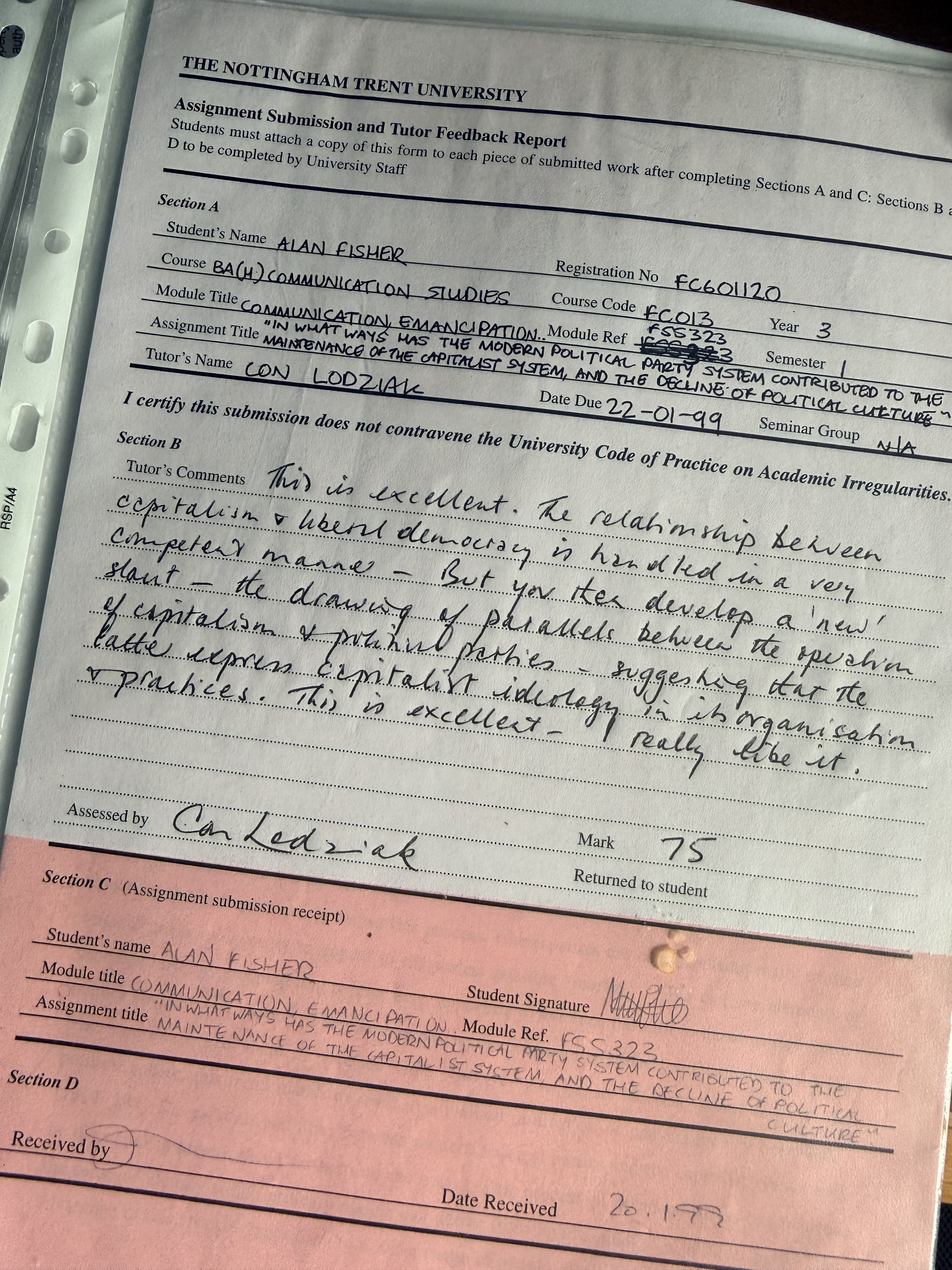
Exhibit D: did I choose subjects like these because I already thought this way, or did studying them teach me to? Answers on a postcard.

Recently I’ve also been looking back through my old academic record, and the subjects I chose and enjoyed now seem suspiciously familiar: Culture and Society, Sociolinguistics, Mass Media, Psychological Perspectives and various excursions into identity, language, culture and the ways people make sense of the world around them.

So which way round did that work?

Was I drawn to those subjects because I was already the sort of person fascinated by groups, identity and how people construct meaning?

Or did spending three years being encouraged to think about those things permanently alter the way I looked at the world?

I suspect the deeply unsatisfying answer is: both.

Perhaps university gave names and structures to questions I was already inclined to ask.

Or perhaps I’ve simply read my own subsequent history and retrofitted another convenient pattern onto it.

There’s a lot of that going on here.

An unreliable sociometer

Another idea from psychology made me slightly more uncomfortable.

Sociometer theory, developed by psychologist Mark Leary and colleagues, proposes that part of the function of self-esteem is to monitor our perceived relational value – essentially, how much we think other people value having us around.

If that’s even approximately right, I suspect mine may occasionally be calibrated a little pessimistically.

There seems to be a recurring tendency for me to demand more evidence than should reasonably be necessary before accepting positive conclusions about myself.

I’ve described myself as suffering from imposter syndrome at work.

Something similar happened with writing.

When I was heavily involved in Forest websites and forums, people occasionally told me they liked things I wrote. Rather than simply accepting this perfectly pleasant information, I wondered whether my established presence in those communities was influencing their reaction.

So I started an entirely anonymous Forest blog.

Looking back my anonymous foray into Forest writing was actually very productive!

This was, although I didn’t describe it this way at the time, essentially an experiment designed to remove the confounding variable of me.

People read that too.

Quite a lot of them, as it happens.

Apparently confronted with evidence that contradicted my hypothesis, I responded in the traditional scientific manner by quietly moving on and finding other things to doubt about myself.

The bigger the crowd, the smaller the world

This also gives me a different way of thinking about my changing relationship with Ferocious Dog.

In the earlier years I could walk into a gig and recognise a ridiculous proportion of the people there. The same faces appeared everywhere. Gigs were gigs, but they were also reunions.

Then the band became more successful and the crowds became bigger.

This was obviously a good thing. I’d spent years writing a blog whose barely concealed purpose was to encourage precisely this outcome.

The bastards eventually listened.

I’m in there somewhere with Ella, at Devil’s Arse, Derbyshire in August 2026.

But something changed for me.

A room containing a thousand people who like the same band as me ought logically to contain more of “my people” than a room containing a hundred of them.

It didn’t feel that way.

There were fewer familiar faces proportionally. Less of the feeling of walking into a room and immediately knowing where you fitted. Covid accelerated the change. People came and went. Lives changed. Mine did too.

For a while I’ve explained that simply as losing some of my passion for the band, and there’s undoubtedly truth in that.

But perhaps something else diminished too.

Not membership of a fanbase.

The density of relationships within it.

Those aren’t necessarily the same thing.

Belonging, but not too much

So where does all this leave me?

Annoyingly, without a diagnosis.

I don’t know whether teenage me moved between friendship groups because it reduced the possibility of rejection.

I don’t know whether my reluctance to assert my place in adult relationships comes from the same place.

I don’t know how much is self-doubt, how much is politeness, how much is independence and how much is simply a personality that quite enjoys wandering between different groups of people.

I don’t even know whether I’ve discovered a pattern here or constructed one because humans are extremely good at finding patterns once they start looking for them.

But I do think I’ve been slightly unfair to myself in describing some of this as an inability to stick at things.

Look beneath the changing interests and there’s actually a surprising amount of continuity.

I’ve been writing and publishing things for most of my life.

I’ve repeatedly sought out communities and formed friendships within them.

I’ve repeatedly been interested in how groups behave.

And I’ve repeatedly resisted allowing membership of those groups to dictate what I’m supposed to think.

Maybe the clique-hopping schoolboy, the Forest fanzine cartoonist, the university student writing about culture and society, the anonymous football blogger, the reluctant Hell Hound and the middle-aged bloke writing increasingly self-indulgent essays on his personal blog aren’t quite as different as they initially appear.

Perhaps I’ve simply spent my life trying to find a comfortable distance from the groups I care about.

Close enough to form real attachments.

Far enough away to retain my independence.

And, sometimes, perhaps rather farther away than necessary because I haven’t quite trusted the evidence that other people actually want me there.

I’m not sure I particularly want to change the first two.

I might want to work on the third.

In the meantime, I’m perfectly happy to belong.

Just don’t make me wear the fucking badge.

Categories: Blog | Tags: , , , , , , , , , , , , , , , | 1 Comment

I bought a NAS and accidentally built a tiny data centre

A couple weeks ago I bought a NAS because I wanted somewhere sensible to store my Plex library (which was sat on a flaky USB hard drive connected to my always-on Mac mini) and provide Time Machine backup for my two Macs.

That was the plan. Simple.

A nice, boring, responsible grown-up storage solution.

Fast forward a couple of weeks and I’ve accidentally-on-purpose built what can only be described as a budget enterprise media bunker with VPN mesh networking, internal DNS routing, automated torrent workflows, dashboard telemetry, HomeKit camera integrations and enough storage to archive a modest Principality.

As these things tend to go.

The heart of it all is a QNAP TS-464 stuffed with four 22TB Toshiba Enterprise drives in Raid 5. Which means:

  • It stores an absurd amount of data, and
  • One drive can die without me immediately entering a state of spiritual collapse.

Originally, the goal was just:

  • Move Plex media off the randomly disconnecting USB drive
  • Centralise Time Machine backups
  • Stop relying on ‘vibes’ as a data resilience strategy

But once the NAS existed, it immediately became obvious it could far more than hold files, as my first job tinkering with the servers at an internet hosting company came screaming from the void of forgotten things in my brain to the forefront. Who knew you could have muscle memory for vi?

Plex moved off the Mac and became a proper always-on media server without having a computer running all the time. Then I added an HDHomeRun Flex Quatro, which basically turned the whole setup into a DIY Sky+/TiVo replacement. Live TV streams around the house now, Plex records broadcasts directly onto the NAS, and somewhere along the line I found myself learning far more about multicast networking than any sane person should. Particularly since I never really watch live TV, haha!

Of course, the second you start self-hosting things, IP addresses begin breeding in dark corners. Suddenly you’re trying to remember whether qBitttorrent lives on :8080 or :8090 and whether Homarr was .71 or .73 and honestly, life is too short for that nonsense.

So naturally I ended up deploying AdGuard Home and Nginx Proxy Manager to create proper internal DNS routing.

Now everything has delightfully nerdy addresses like:

  • adguard.home.arpa
  • nas.home.arpa
  • router.home.arpa
  • etc..

Which makes the whole thing feel dramatically more professional than it probably is (and certainly more so than it needs to be!).

Then came the dashboard phase.

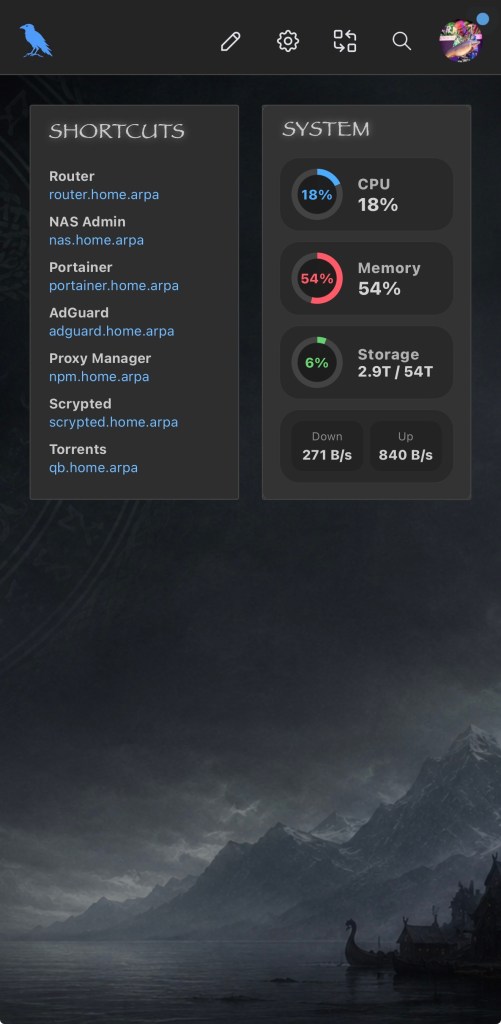
Homarr dashboard on mobile

I discovered Homarr and immediately lost a few hours redesigning widgets that nobody except me will probably ever properly appreciate.

But now I’ve got a mobile-friendly dashboard that surfaces quick links to the assorted things installed on there, NAS stats, services health and other telemetry so I can feel like I’m managing a tiny data centre from the sofa (which I suppose I am!).

It works beautifully as a web app on my iPhone.

And because I’m apparently incapable of leaving things alone, I also wanted all of this available remotely.

Securely, naturally.

Without opening horrifying holes in the router.

Enter Tailscale – which honestly feels like cheating. Suddenly my phone and laptop behave as though they’re still inside the home network even when I’m elsewhere. My entire Homarr dashboard, internal services and admin tools now work remotely as though the house itself has been quietly stuffed in my pocket.

The ‘tiny but brilliant’ things are probably my favourite parts though.

For example: I now have a non-HomeKit compatible doorbell camera appearing inside Apple Home because Scrypted is essentially digital witchcraft.

My torrent setup can accept magnet links emailed to a dummy address, automatically feed them into qBittorrent, then email me when the download is complete like some sort of shady digital butler.

The Nvidia Shield TV Pro has also evolved into an absurdly polished media appliance. Projectivy Launcher cleaned the interface of all the Google cruft, Surfshark selectively routes only certain apps through VPN, and assorted apps cover the combination of things I stream externally and internally on Plex. The whole thing feels smoother and cleaner than most commercial streaming boxes I’ve encountered.

Somewhere along the way I also accidentally reawakened the person who gets excited by:

  • Reverse proxies
  • SSL certificates
  • DNS propagation
  • Multicast traffic
  • Graceful UPS shutdown behaviour
    Whether dashboards have the correct border radius

I regret nothing.

What I love most is that it not longer feels like a pile of separate gadgets.

Everything talks to everything else.

The NAS handles storage and services. Plex handles media. HDHomeRun handles TV. AdGuard handles DNS. Tailscale stitches the entire thing remotely. Homarr surfaces everything cleanly. The Shield makes it pleasant to actually use day to day.

And underneath all the nerdy nonsense, the original goal still quietly works perfectly: the Macs backup automatically, the Plex library is centralised, and everything feels vastly more robust than it did before.

It’s just that the “simple NAS storage project” accidentally evolved into a full-blown self-hosted ecosystem somewhere along the way – thanks to a geeky tendency, awareness of the kind of things that could be achieved – that can, thanks to the power of AI assistants, be converted into clear step by step instructions to achieve what you need!

I’m sure there’ll be more tinkering to come…

Categories: Blog | Tags: , , , , , , , , , | Leave a comment

Accidental performer..

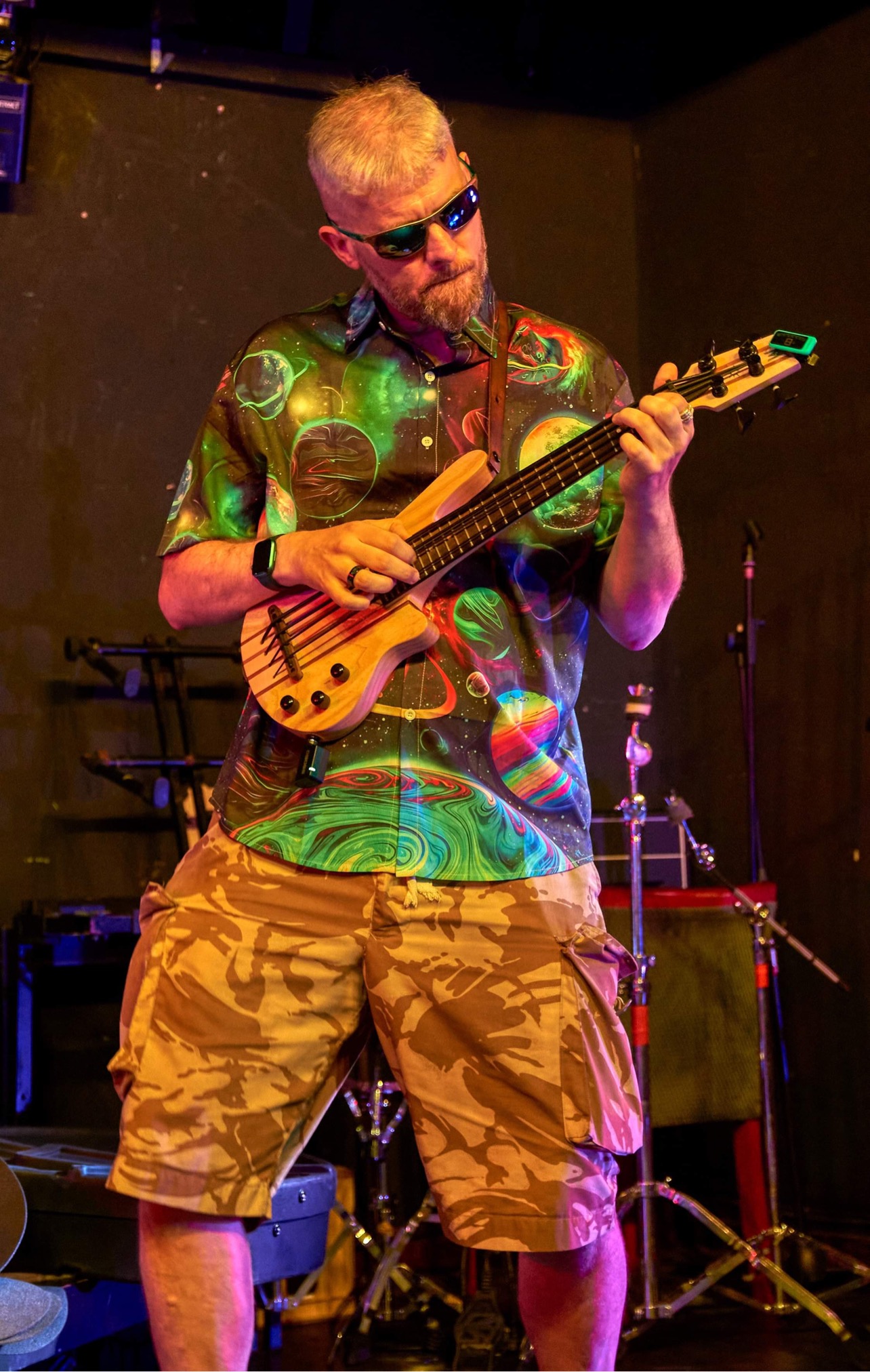
It’s important to remember to pack the correct bass before a gig…

For somebody with no inherent musical skill – probably as a result of singularly failing to engage with opportunities to learn music at school, something I’d love to have a word with past-Alan about – it’s a bit of a surprise how much musical performance I’ve ended up doing over the last few years.

My first foray was with the Star Copiers – a venture that started with two friends who were learning guitar, a challenge set by a friend organising a festival that saw a fledgling band start along with another friend on vocal duties.

After they’d performed a few times, at another festival a drunken conversation with Mark saw me say something foolish like “you know what you need, someone to sit on one of those box things to keep you in time“, “Good idea!” he said “You’ve got the job – go and buy one of those box things!

And so it began, I managed to bash my way through the first cheap eBay cajon (and learned what a cajon was called), so bought a more expensive one, visiting a dealer in his warehouse and feeling like a massive fraud – and well, we actually managed to secure some pretty cool gigs for a bunch of mates pissing around covering songs in our own inimitable style. We even recorded a couple of songs and released them into the wild to raise money for St. Giles hospice, even securing a donation in exchange for some t-shirts from the frontman of Alice Donut, the band whose song we covered in tribute to our dear friend Richard.

Along the way I was invited to perform on my box with Ferocious Dog, Nick Parker, Dis-honest Foke, Morganella and a fair few other artists. It’s funny how things escalate from one throwaway comment at a festival, isn’t it?

As the Star Copiers fizzled out, the Car Boot Bandits came to the fore – pretty much the same deal from my point of view, cover versions (and one original song – which I wrote after learning to butcher a few chords on a ukulele), but then Covid-19 landed and it really took the wind out of the band sails, never managing to reconvene after the world closed down for a year and a bit. That said, I did record a song for Pete Drake (another artist I’ve box-banged with!) utilising ukuleles, cajon and some backing vocals from Ella for his Pete Drake Project album under the Car Boots Bandits name, despite the rest of the band not being involved due to lockdown restrictions.

Something submitted jokingly to Radio Nottingham of our only original song saw the local station make some kind of collaboration/mash-up with LadBaby too. I wasn’t sure whether to be honoured or horrified!

Running in parallel with these acts were Darwin’s Rejects – another group of festival friends, but with I think it’s fair to say a more ambitious end-game. Sometimes at festivals we mix-and-matched line-ups on festival open-mic stages, usually under the name of the Egyptian Whores. A couple of times when their percussionist Jim wasn’t available for a gig I was asked to deputise on my box – a real honour and always fun! At this time mostly a cover band too, but with a couple of their own songs in the mix. It made me realise how much I’d missed both the performing aspect of being in a band, but also the camaraderie of rehearsals.

It must have been obvious to everyone else, not least Ella as well as the rest of the Darwin’s (at that time) boys. A plan was hatched. Warren had determined the missing piece for the band’s sound was bass guitar, “you could learn that” he said to me I thought jokingly when we were rehearsing ahead of a gig I was covering for Jim. I didn’t take it too seriously, albeit idly fantasising that this could be a cool idea. Bass is like a fusion of percussion and guitar really after all!

In the background this conversation carried on between Warren and Ella – and on Christmas morning 2022 a lovely rubber stringed bass ukulele was under the tree for me. Okay, I might have got wind of this before Christmas even if I wasn’t permitted to open it before then! I dutifully signed up to some bass resources online and started to methodically try to learn to play, and progressed pretty well – but with gigs mounting up and me trying to learn ‘properly’ rehearsals left me feeling very out of my depth.

So I refocused, I developed a ‘cheat sheet’ template (initially on paper, now on an iPad) and realised that whilst I wouldn’t be a virtuoso I could get away with moving around mostly root notes to add some passable depth to our songs. Initially training myself to move round the fretboard I probably did one note per bar, but then built up to add some different patterns to lock into Jim’s drums. I progressed more quickly – I was on stage within a couple of months for my debut a couple of months from receiving my first bass guitar. Terrifying and thrilling in equal measure.

Since then we’ve been working on more of our own material – I love the collaborative approach, working out what patterns sound best for my parts, I’ve even offered up songs of my own which sates the creative writing dearth as we’re trying to work up enough songs to make up what will be our debut album later this year. The EP we released last year came a little too soon for me to actually play on so whilst I can merrily play those songs now, back then it made more sense for Warren to do it – so from a personal pride point of view I’m excited to actually have my own contributions laid down in recordings.

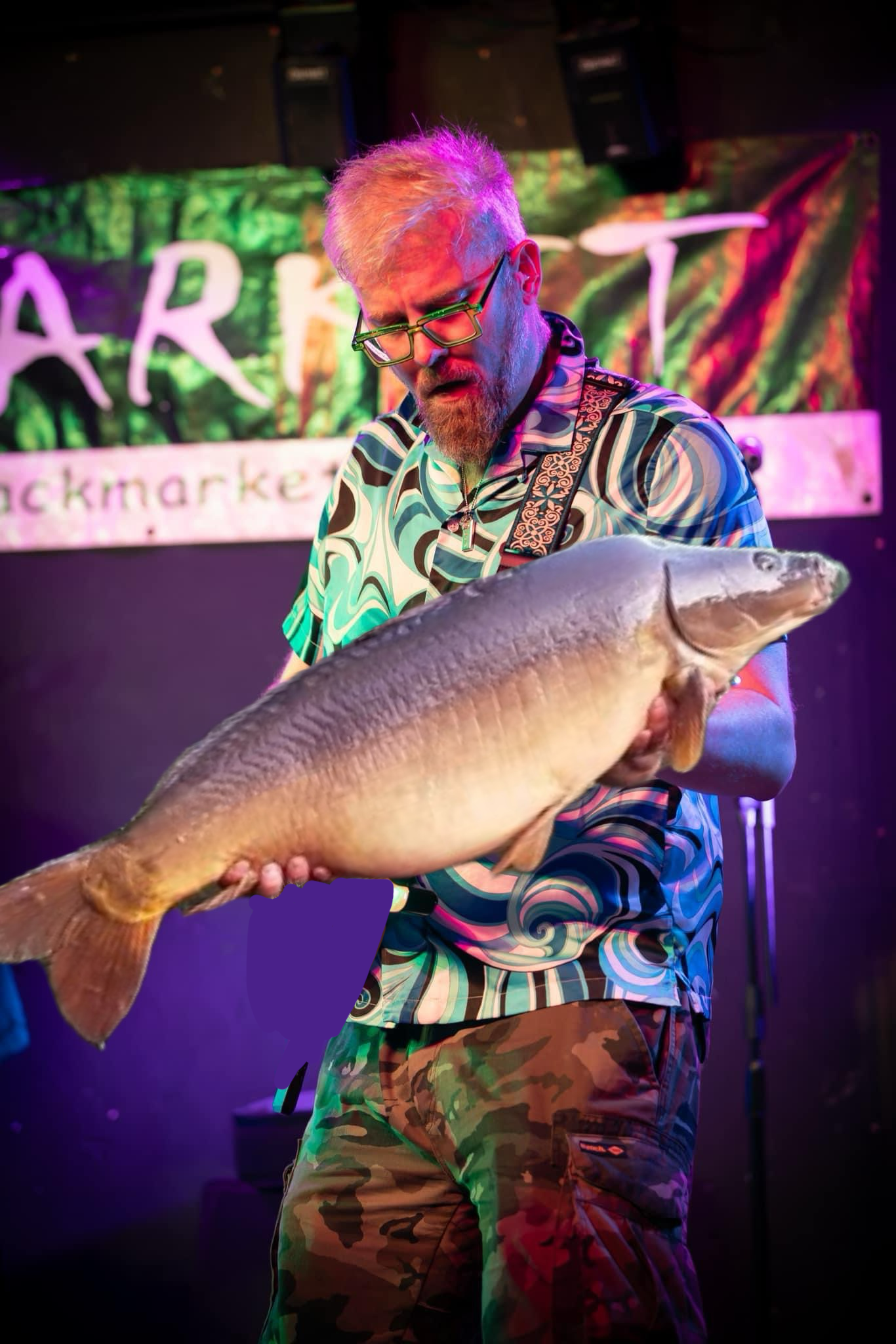
So yeah, the accidental performer thing seems to be such a recurring theme that it must just be something about me – I absolutely love being on a stage and hopefully contributing to something that people are enjoying. We’ve had some great feedback and I’m really excited about some of the things we’ve been working on that have yet to make it out into the wild – all of this stems back to innocently making a suggestion to Mark all those years ago about the need for a dude sitting on a box keeping time.

In the meantime I now have a choice of two basses – both ukulele sized albeit tuned like.a regular bass guitar, I like the quirkiness and convenience of size, a choice in pedal set ups, an amp – hmm, expensive hobby indeed. That’s what Russ always describes being in a grassroots band as being – and he’s not wrong, haha! But it’s a whole lot of fun!

Categories: Blog, Darwin's Rejects, Ferocious Dog, Music, Videos | Tags: , | Leave a comment

Blog at WordPress.com.