Or how a weekend in Whitby turned into a thousand-year detour
There’s something rather liberating about being a passenger in a car. For years, whenever we went anywhere, I did most of the driving. Which meant that, while I could appreciate the scenery, my attention was generally occupied by rather more pressing matters, like other road users, speed limits and trying not to miss a turning.
These days Ella does the lion’s share of the driving, and on our way to a weekend in Whitby I found myself enjoying the increasingly familiar luxury of gazing out of the window, watching the world go by and generally being a nuisance by pointing out things that probably don’t warrant quite so much attention.
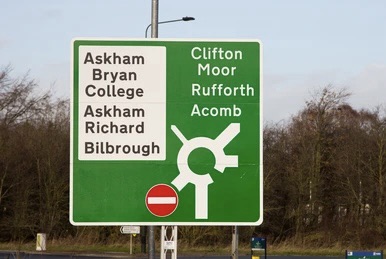
Which is how I came to notice two road signs near York.
Askham Richard. Askham Bryan.
Now, I don’t know about you, but those are splendidly peculiar names for neighbouring villages. They sound less like places and more like two blokes who ought to be propping up the bar in a country pub.
Why Richard? Why Bryan? Were they brothers? Rivals? Had one done something sufficiently impressive to get a village named after him, prompting the other to demand equal recognition?
As it turns out, the answer takes us back nearly a thousand years.
A village among the ash trees
Before Richard and Bryan came along, there was simply Askham, recorded in the Domesday Book of 1086 as Ascam. Its name is generally interpreted as referring to a settlement associated with ash trees, with linguistic roots stretching back into Anglo-Saxon England and potentially reflecting the Scandinavian influence so prevalent in Yorkshire.
There’s something pleasing about that. Before the noblemen, before the Norman Conquest, somebody simply identified a settlement by the trees growing around it. The medieval equivalent of giving directions by saying, “You know, that place by the big tree.”
Before 1066, the land belonged to Edwin, Earl of Mercia, one of the most powerful noblemen in Anglo-Saxon England. Unfortunately for Edwin, William of Normandy had other ideas about who should own England.
The Norman Conquest wasn’t quite the straightforward change of management that school history lessons sometimes suggest. Northern England proved particularly troublesome, culminating in William’s devastating Harrying of the North in 1069–70, during which settlements, crops and livestock were destroyed on a terrible scale.
Edwin himself was killed in 1071, and his vast estates were redistributed among the new Norman aristocracy. By the time of the Domesday survey, Askham was in the hands of Count Alan of Brittany.
Our little settlement among the ash trees had become part of an enormous rearrangement of English landownership.
Enter Richard and Bryan
Over the following centuries, the lands around Askham developed into two distinct manors, known as Great or East Askham and Little or West Askham.
The Richard in Askham Richard is traditionally identified as Richard, Earl of Cornwall, younger brother of Henry III. He was spectacularly wealthy, politically influential and, in 1257, elected King of the Romans, a title associated with the Holy Roman Empire.
Quite the career for someone whose name now appears on a road sign outside York.
Bryan, meanwhile, is associated with Brian FitzAlan, a member of a powerful northern aristocratic family whose connections with the manor gave Askham Bryan its distinguishing name.
So our two Askhams weren’t named to celebrate some great local achievement. They were distinguished by their association with powerful landowners. In an age before postcodes and Google Maps, identifying a settlement by the person who controlled it was an entirely practical solution.
Essentially, the road signs we’d passed were medieval property labels that had somehow survived into the twenty-first century.
And they’ve survived remarkably well. Both names appear in records from the fourteenth century, meaning people were distinguishing the two settlements by Richard and Bryan more than six hundred years ago.
The history we drive straight past
There’s something rather wonderful about that. Edwin, who once controlled enormous estates across England, lost everything. The Norman aristocracy who replaced him fought, married, inherited and quarrelled their way through centuries of landownership. Dynasties rose and fell, kings came and went, and England changed beyond recognition.
Yet Richard and Bryan remain, casually invoked by motorists looking for somewhere to turn off the road.
Perhaps what appeals to me most about this little discovery is how completely accidental it was. We weren’t visiting a castle, exploring an abbey or deliberately seeking out a historic site. We were simply heading to Whitby for the weekend.
Had I been driving, I might have glanced at the signs, registered them for half a second and promptly forgotten them while concentrating on the road.
Instead, being relieved of driving duties gave me the opportunity to wonder why two villages so close together had such curiously personal names.
That idle thought led from a couple of road signs to Anglo-Saxon settlements, Viking language, the Norman Conquest, dispossessed earls and medieval aristocrats. All without leaving the passenger seat.
Britain is full of these things. Names we barely notice, whose meanings have been worn smooth by centuries of everyday use. Every village, street, field and river potentially has a story to tell, if we’re sufficiently curious to ask.
So, thank you to Ella for doing the driving. Although I suspect she may eventually come to regret the arrangement if every interesting road sign results in an unsolicited lecture on medieval land tenure.
We hadn’t even reached Whitby.
And I’d already managed to travel back a thousand years.


Recent Comments